

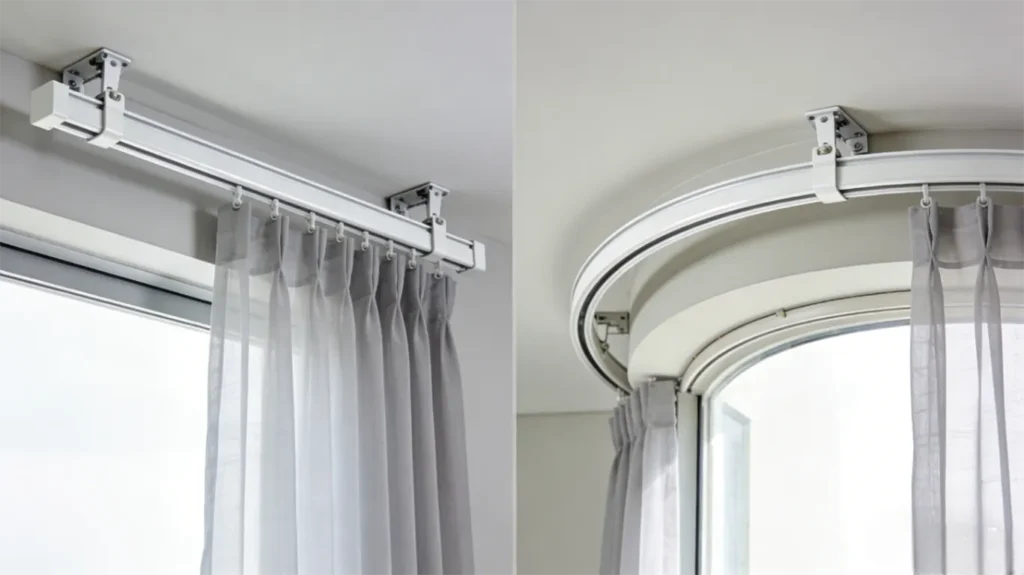
Introduction: Why the Right Curtain Track Matters in Commercial Design
Choosing between a curved curtain track and a straight curtain track is not only a decorative decision. For B2B project managers, architects, general contractors, and procurement teams, this selection influences:
- Project installation efficiency
- Long-term durability and maintenance cost
- Space utilization and guest privacy
- Interior design continuity
- Compliance with hygiene or safety regulations (such as hospital environments)
As modern architecture increasingly uses panoramic windows, curved walls, and separated functional zones, demand for custom curved curtain track systems continues to rise across hospitality, healthcare, and commercial interiors.
This guide compares performance, applications, installation methods, and procurement considerations to help buyers make the most cost-effective decision.
What Is a Curved Curtain Track?
A curved curtain track is an aluminum rail system engineered for spaces with:
- Bay windows
- U-shaped or L-shaped corners
- Hospital ward cubicles
- Round shower spaces
- Hotel suite separations
- Ceiling-mounted partitioning
High-precision bending ensures smooth curtain movement along curved geometry. Most commercial solutions use 6063-T5 aluminum, offering:
| Specification | Typical Commercial Grade |
|---|---|
| Alloy Material | 6063-T5 Anodized Aluminum |
| Max. Continuous Bend | R ≥ 300mm |
| Load-Bearing | 10–25 kg per meter |
| Installation | Ceiling-mount or wall-mount |
| Coating | Corrosion-resistant powder coating |
Its flexibility solves gaps that straight rods cannot handle.
What Is a Straight Curtain Track?
A straight curtain track is designed for linear coverage. It is most common in:
- Standard hotel rooms
- Residential windows
- Office windows
- Meeting spaces
Strength can vary widely depending on material thickness and rollers used. It remains cost-efficient for basic installations with no architectural curves.
Curved Track vs Straight Track: Performance Comparison
| Feature | Curved Curtain Track | Straight Curtain Track |
|---|---|---|
| Space Coverage | Ideal for corners & arcs | Only works on straight lines |
| Aesthetic Continuity | Excellent — no light leaks | May create visual breaks |
| Privacy Performance | Higher — full enclosure | Limited coverage |
| Installation | Requires precise bending | Faster & easier |
| Structural Strength | Heavy-duty options available | Varies & sometimes limited |
| Cost | Higher due to customization | Budget-friendly |
| B2B Use Cases | Hotels, hospitals, partition systems | Standard rooms & windows |
Application Scenarios for B2B Projects
Hotels & Resorts
- Ceiling-mounted curved tracks create immersive drapery around panoramic windows
- Perfect for corner rooms, suites, luxury soft partitions
Healthcare & Hospitals
- Medical-grade curved cubicle tracks support infection control
- Fully enclose treatment space for privacy compliance
Commercial Offices
- Create flexible zones without permanent walls
- Used in co-working, showrooms, consultation spaces
Retail & Exhibition
- Structure-friendly partitions with curtain-based pathways
➡️ If the architecture contains angles, turns, rounded spaces → curved track saves construction cost versus custom carpentry.
Functional & Mechanical Differences
Smooth Operation
Curved tracks require:
- Low-friction roller carriers
- High-precision radius bending
- “No-jump” track joints
Some offer nylon-wheel roller carriers with noise control < 30dB.
Weight Capacity
Heavy-duty curved models support:
Up to 25 kg/m curtain load
Suitable for hotel blackout drapes + sheers double-layer system
Straight tracks:
Typically 10–15 kg/m
Hygiene & Safety
Healthcare track coating often includes:
- Anti-bacterial surface
- Fire-retardant certifications (Depends on region: NFPA 701 / BS 5867)
Installation Considerations & Cost Evaluation
| Factor | Curved | Straight |
|---|---|---|
| Measurement Requirement | High accuracy | Standard |
| On-site Labor | Skilled installation required | Fast installation |
| Lead Time | Usually custom production | Stock available |
| Total Cost | Medium-High | Low-Medium |
B2B cost must consider:
- Lifetime maintenance
- Curtain weight upgrades
- Replacement frequency
When misalignment appears, curved tracks remain more durable due to structural geometry.
Why More Commercial Projects Choose Curved Tracks
✔ Fits architectural design without compromises
✔ Better privacy — no corner gaps
✔ Higher aesthetic value → improved guest satisfaction
✔ Flexible partitioning with no permanent walls
✔ Support OEM / ODM customization for contractors
Growing use in:
Hospitality, healthcare, education, public facilities, commercial buildings
Key Technical Specs When Sourcing Curved Curtain Tracks
Checklist for procurement:
| Critical Specs | Recommended for B2B |
|---|---|
| Aluminum Alloy | 6063-T5 or higher |
| Track Thickness | ≥ 1.2mm |
| Bend Radius | Custom R ≥ 300mm |
| Load Rating | ≥ 20 kg/m |
| Surface Treatment | Anodizing or powder-coating |
| Installation | Ceiling-mounted suspension options |
| Roller System | Nylon silent carriers / ball-bearing carriers |
| End Stop | Anti-fall locking caps |
▶ Always request sample & load test report before bulk order
How to Decide: A Practical Selection Guide
| Project Type | Best Choice |
|---|---|
| Standard linear rooms | Straight track system |
| Irregular windows / bay windows | Curved curtain track |
| Hotels with interior zoning | Curved ceiling-mount |
| Hospital ward privacy | Anti-bacterial curved track |
| Low-budget development | Straight track |
➡️ Rule of thumb:
Straight for simplicity
Curved for professional commercial results
Conclusion
For commercial interiors, curved curtain tracks deliver benefits straight tracks cannot achieve — privacy sealing, architectural fit, and visual continuity. Although straight systems offer lower upfront cost and faster installation, curved tracks are superior for:
- Complex layouts
- Heavy hotel drapery
- Healthcare zoning
- Luxury design standards
When purchasing for B2B projects, always evaluate load capacity, bending precision, installation support, and maintenance. A well-engineered heavy-duty curved curtain track ensures long-term value and enhances the overall spatial experience in hospitality and healthcare environments.