

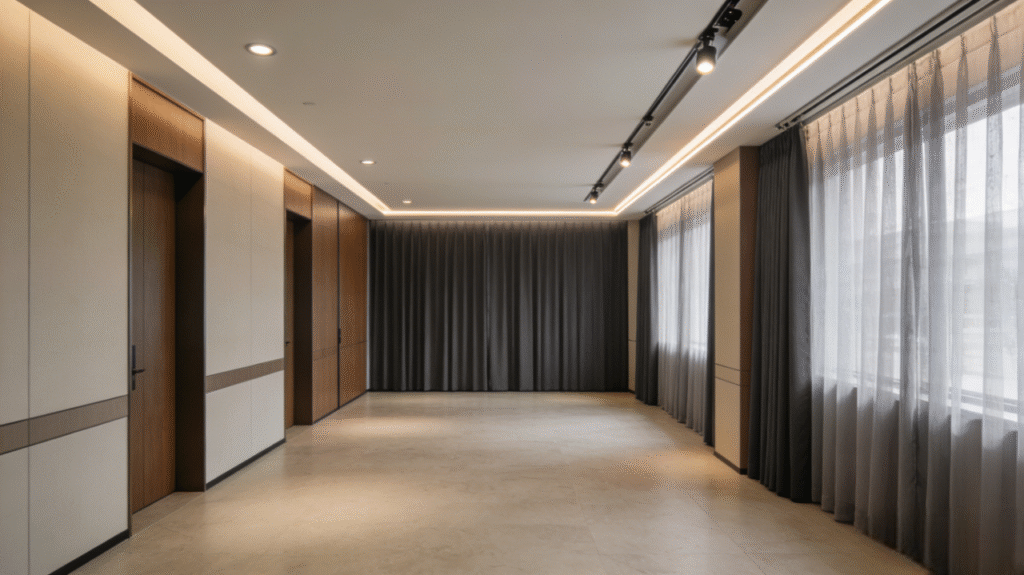
Introduction: Why This Comparison Matters in Commercial Projects
In commercial and large-scale residential projects, curtain hanging systems are not a decorative detail—they are a functional infrastructure component. The choice between curtain tracks and curtain rods directly affects installation efficiency, operational reliability, maintenance costs, and long-term project performance.
While curtain rods are still commonly used in small residential applications, curtain tracks are increasingly specified in hotels, offices, hospitals, and large developments.
This raises a practical, performance-driven question for B2B buyers:
Between curtain tracks vs curtain rods, which system actually performs better in commercial projects?
This article answers that question using engineering logic, technical parameters, and real project considerations, rather than aesthetic preference.
1. Structural Performance: Load Capacity and Weight Distribution
1.1 Load Distribution Mechanics
The most fundamental difference between curtain tracks and curtain rods lies in how load is distributed.
- Curtain tracks distribute curtain weight continuously along the rail.
- Curtain rods concentrate load at fixed wall brackets.
Typical performance parameters:
| System | Load Distribution | Recommended Load |
|---|---|---|
| Curtain Track (Heavy-Duty) | Continuous | 30–60 kg |
| Curtain Rod | Point-based | 10–20 kg |
For wide windows, floor-to-ceiling curtains, and blackout fabrics, curtain tracks offer significantly better structural stability.
1.2 Deflection and Long-Span Performance
In commercial environments, spans often exceed 2.5–4 meters.
- Curtain rods are prone to sagging over long spans.
- Curtain tracks maintain alignment due to ceiling support and continuous fixing points.
This explains why curtain tracks are preferred in:
- Hotel guest rooms
- Conference halls
- Office curtain partitions
2. Installation Efficiency in Commercial Projects
2.1 Standardization and Speed
Curtain track systems are designed for standardized installation, which is critical for large projects.
Common specifications:
- Track length: 3 m / 4 m / 5.8 m
- Aluminum thickness: 1.2–2.0 mm
- Fixing interval: 400–600 mm
This allows installers to:
- Work faster
- Reduce on-site errors
- Maintain consistent results across hundreds of rooms
Curtain rods, by contrast, require precise wall drilling and alignment for each unit.
2.2 Installation Surface Compatibility
Curtain tracks support:
- Concrete ceilings
- Steel structures
- Suspended ceilings
- Concealed ceiling recesses
Curtain rods are limited to load-bearing wall surfaces, which restricts layout flexibility in modern architectural designs.
3. Operational Performance: Daily Use and Wear Resistance
3.1 Smoothness and Noise Control
High-quality curtain tracks use:
- POM or nylon rollers
- Precision-extruded aluminum profiles
- Low-friction track grooves
Typical operating noise: ≤30 dB
Curtain rods rely on metal or plastic rings, which:
- Generate more noise
- Increase friction
- Accelerate fabric wear
In hotels and offices, quiet operation is a critical performance metric, giving curtain tracks a clear advantage.
3.2 Durability Under High-Frequency Use
In commercial projects:
- Curtains may be opened and closed multiple times daily
- Systems must withstand long-term repetitive motion
Curtain tracks are engineered for:
- 50,000+ operation cycles
- Minimal roller degradation
Curtain rods are not typically tested for this level of use.
4. Design Flexibility and System Integration
4.1 Layout Freedom
Curtain tracks support:
- Curved layouts
- Bay windows
- Multi-layer systems (sheer + blackout)
- Full-height curtains
Curtain rods struggle with curved or corner designs and often require custom solutions.
4.2 Motorization and Smart Building Compatibility
Modern commercial projects increasingly require automation readiness.
Curtain tracks can integrate with:
- Motor torque: 1.2–2.0 Nm
- Curtain weight: up to 50 kg
- Control systems: wall switch, remote, BMS
Curtain rods are rarely compatible with motorized systems without structural compromise.
5. Maintenance, Replacement, and Lifecycle Cost
5.1 Maintenance Efficiency
Curtain tracks:
- Allow easy roller replacement
- Support modular repair
- Require minimal re-alignment
Curtain rods often require:
- Full disassembly
- Wall repair during replacement
5.2 Total Cost of Ownership (TCO)
Although curtain tracks may cost more initially, their lifecycle cost is lower due to:
- Reduced maintenance
- Longer service life
- Lower failure rates
For B2B buyers managing multiple projects, TCO is often more important than unit price.
6. Safety, Compliance, and Project Standards
In public and commercial buildings, safety is non-negotiable.
Curtain tracks can meet:
- Load safety factors ≥2.0
- Fire resistance requirements
- Corrosion resistance (anodized aluminum)
These features make curtain tracks suitable for:
- Hospitals
- Schools
- Public buildings
Curtain rods are rarely specified in these environments.
7. Which System Should B2B Buyers Choose?
Curtain Tracks Are Better For:
- Hotels and hospitality projects
- Offices and commercial buildings
- Large residential developments
- Projects requiring automation
- Long-span or heavy curtain applications
Curtain Rods Are Suitable For:
- Small residential projects
- Decorative applications
- Low-frequency use environments
Conclusion: Curtain Tracks vs Curtain Rods — Performance Defines the Winner
When comparing curtain tracks vs curtain rods in commercial projects, the conclusion is clear: curtain tracks deliver superior performance in terms of load capacity, installation efficiency, durability, design flexibility, and lifecycle cost.
For contractors, developers, and project buyers, curtain tracks are not simply an alternative—they are a project-grade system designed for reliability, scalability, and long-term value.