

Introduction: Why Curtain Track FAQs Matter for B2B Buyers
For B2B buyers—including interior contractors, hotel project managers, wholesalers, and architects—curtain track installation and long-term performance directly impact project quality and lifecycle costs. Unlike residential end users, B2B customers prioritize load capacity, installation efficiency, durability testing, and compatibility with large-scale projects.
This article compiles the most frequently asked questions about curtain track installation and use, based on real-world commercial applications. The goal is to help professionals reduce installation errors, avoid premature failures, and select technically suitable curtain track systems.
FAQ 1: What Types of Curtain Tracks Are Commonly Used in Commercial Projects?
The most common commercial curtain track types include:
1. Aluminum Curtain Tracks
- Widely used in hotels, apartments, and offices
- Lightweight but structurally stable
- Typical load capacity: 25–40 kg per meter
- Surface treatments: anodized, powder-coated
2. Stainless Steel Curtain Tracks
- Designed for heavy drapes and acoustic curtains
- Load capacity can reach 60–70 kg per meter
- High corrosion resistance, suitable for coastal or humid areas
3. Plastic Curtain Tracks
- Used for lightweight curtains or temporary installations
- Load capacity generally below 15 kg per meter
- Lower durability, limited B2B usage
Technical Insight:
For projects requiring curved or irregular window shapes, aluminum and stainless steel tracks can be factory pre-bent with a recommended minimum bending radius of ≥150 mm for heavy curtains to ensure smooth gliding.
FAQ 2: How Do You Determine the Correct Load Capacity for Curtain Tracks?
Load capacity is one of the most critical technical parameters for B2B buyers.
Key factors include:
- Curtain fabric weight (g/m²)
- Curtain width and pleating ratio (1.8x–2.5x)
- Accessories such as hooks and carriers
Industry Reference Values:
- Medium fabric curtains: 12–18 kg per panel
- Heavy blackout or acoustic curtains: 30–45 kg per panel
Professional Recommendation:
Always select curtain tracks with a 20–30% safety margin above the calculated curtain weight. For example, a 40 kg curtain system should use tracks rated for at least 50 kg/m.
FAQ 3: What Is the Best Installation Method for Commercial Curtain Tracks?
1. Ceiling-Mounted Curtain Tracks
- Most common in hotels and high-end residences
- Ideal for floor-to-ceiling curtains
- Supports heavier loads with even weight distribution
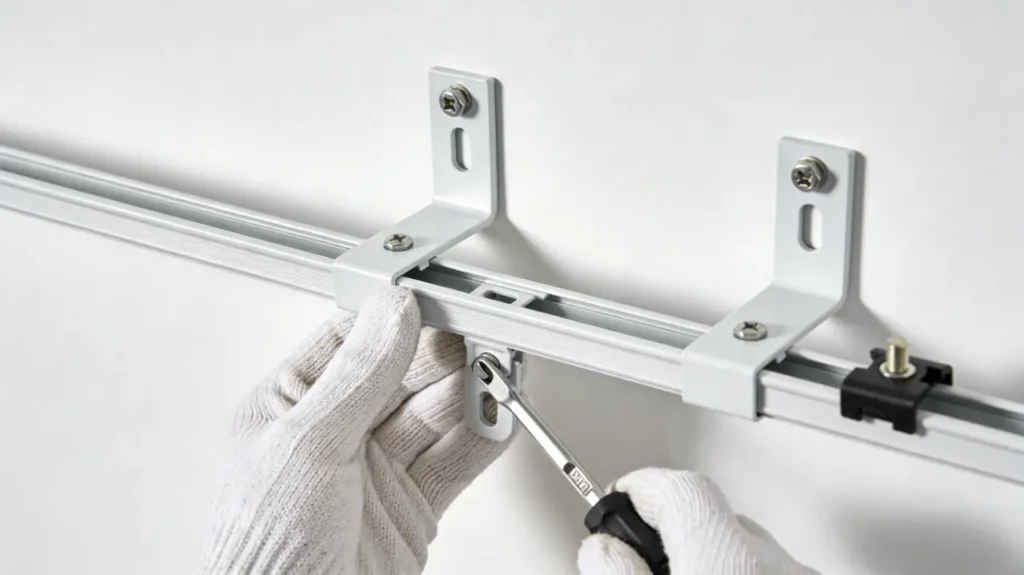
2. Wall-Mounted Curtain Tracks
- Suitable when ceiling installation is restricted
- Requires reinforced brackets for heavy curtains
3. Recessed or Concealed Tracks
- Integrated into ceiling coves or pelmets
- Requires precise pre-installation planning
Installation Tip (Professional Use):
For tracks longer than 4 meters, intermediate brackets should be installed every 1–1.2 meters to prevent deflection.
FAQ 4: How Are Curved Curtain Tracks Installed Correctly?
Curved curtain tracks are commonly used for:
- Bay windows
- Hotel corner windows
- Curved glass facades
Key Technical Considerations:
- Pre-bending accuracy (±2 mm tolerance)
- Uniform glider spacing (typically 60–80 mm)
- Reduced friction at curve joints
Advanced Detail:
For heavy curtains, segmented curved tracks should include reinforced joint connectors to avoid stress concentration at curve transitions.
FAQ 5: Why Do Curtain Tracks Become Noisy or Hard to Slide?
Common causes include:
- Dust accumulation in the track channel
- Worn or low-quality gliders
- Track deformation due to overloading
Professional Maintenance Standards:
- Clean tracks every 6 months in commercial spaces
- Use silicone-based lubricant, avoid oil-based products
- Replace gliders after 50,000–70,000 cycles
FAQ 6: How Long Should Commercial Curtain Tracks Last?
High-quality commercial curtain tracks typically offer:
- 8–12 years of service life under normal usage
- Tested for ≥50,000 sliding cycles at maximum rated load
Choosing suppliers that provide:
- Replacement gliders
- Technical documentation
- After-sales support
is essential for long-term B2B project reliability.
FAQ 7: What Certifications or Standards Should B2B Buyers Look For?
Professional curtain track systems may comply with:
- ISO 9001 manufacturing standards
- SGS load and durability testing
- Fire-retardant compatibility for hotel projects
These certifications reinforce EEAT signals for procurement decisions.
Conclusion: Key Takeaways for B2B Curtain Track Selection
For B2B buyers, curtain track installation and usage is a technical decision, not merely a decorative one. Understanding material types, load capacity, installation methods, curved track solutions, and maintenance standards helps ensure smooth operation, safety, and long-term durability.
By choosing professionally tested curtain track systems and following proper installation guidelines, businesses can reduce maintenance costs, prevent failures, and deliver consistent quality across commercial projects.
Investing in the right curtain track solution ultimately enhances project reliability, client satisfaction, and brand credibility.