

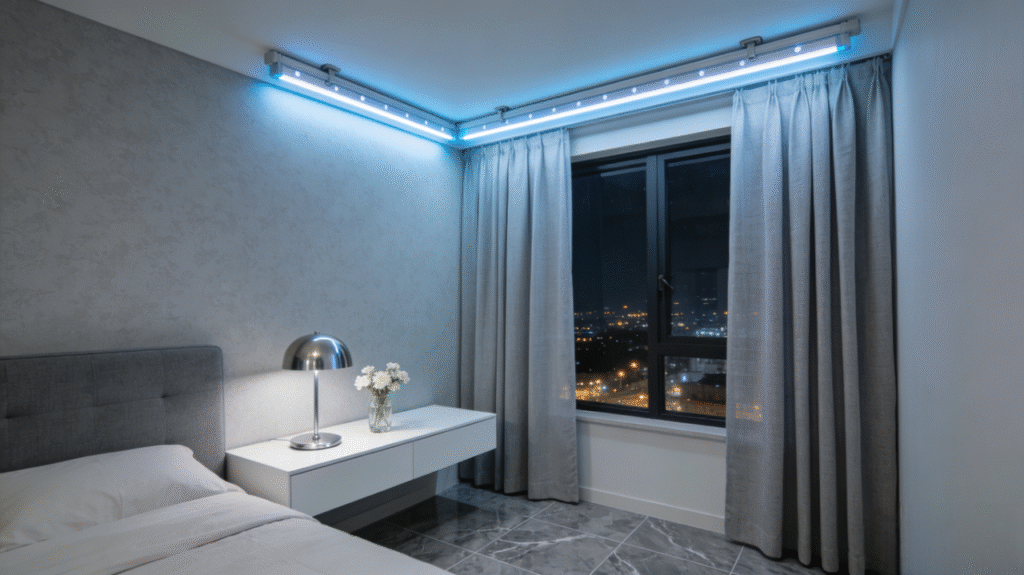
The Evolution of Curtain Track Systems
Traditional curtain tracks served a single mechanical purpose: supporting and guiding curtains. Over the past decade, interior architecture has increasingly emphasized integration, where lighting, shading, and smart controls converge.
LED curtain tracks represent this evolution:
- From standalone hardware → integrated lighting system
- From decorative add-on → functional ambient lighting layer
- From consumer novelty → project-grade building component
By 2026, LED curtain tracks align with how modern spaces are designed and delivered
Key Market Drivers Behind LED Curtain Track Adoption
1. Integrated Architectural Lighting Trends
Architects and interior designers now prioritize clean ceiling lines and minimal fixtures. LED curtain tracks reduce visual clutter by combining:
- Curtain rail
- Linear ambient lighting
- Optional smart control
For developers, this integration simplifies coordination between lighting and curtain suppliers, reducing installation conflicts.
B2B Search Intent Keywords: architectural LED curtain track, integrated curtain lighting system
2. Energy Efficiency & Compliance Requirements
Global energy regulations increasingly favor low-voltage, high-efficiency lighting systems.
Typical LED curtain track specifications:
- Voltage: 24V DC
- Power consumption: 8–14 W/m
- Luminous efficacy: 90–120 lm/W
Compared to traditional downlights, LED curtain tracks provide ambient illumination with lower glare and lower wattage per square meter.
Procurement Insight: Many projects now require documented energy performance data during tender stages.
3. Growth of Smart Homes and Smart Buildings
By 2026, smart lighting control is no longer optional in mid- to high-end projects.
Modern LED curtain tracks support:
- DALI / 0–10V / TRIAC dimming
- Smart ecosystems (Tuya, Zigbee, KNX)
- Tunable white (2700K–4000K)
For B2B buyers, compatibility with existing control infrastructure is a decisive factor.
Long-tail Keyword: smart LED curtain track system for projects
4. Improved Manufacturing & Supply Chain Maturity
Earlier LED curtain track products suffered from:
- Inconsistent light output
- Poor thermal management
- Limited load capacity
By 2026, leading manufacturers offer:
- 6063-T5 aluminum profiles with optimized heat dissipation
- Reinforced track structures (≥50 kg/m load)
- COB LED strips with dot-free light
This manufacturing maturity makes LED curtain tracks viable for large-scale commercial use.
Why B2B Buyers Are Driving Demand (Not End Consumers)
While consumers appreciate aesthetics, B2B clients focus on reliability, scalability, and ROI.
For Developers
- Higher perceived property value
- Stronger marketing differentiation
- Reduced ceiling fixture count
For Contractors
- Fewer installation steps
- Lower coordination errors
- Standardized modules
For Wholesalers & OEMs
- Higher unit value
- Customization opportunities
- Repeat orders from project clients
Application Scenarios: Living Rooms vs Bedrooms
Living Room Applications
- Brightness: 600–900 lm/m
- CCT: 3000K–4000K
- Purpose: Spatial expansion, layered lighting
Bedroom Applications
- Brightness: 300–500 lm/m
- CCT: 2700K–3000K
- Noise control: runner noise ≤25 dB
Design Trend: Bedrooms increasingly specify LED curtain tracks as primary ambient lighting, not just decorative accents.
Technical Parameters B2B Buyers Should Evaluate
- Track straightness tolerance: ≤1.5 mm/m
- LED strip lifespan: ≥50,000 hours (L80)
- Driver efficiency: ≥88%
- IP rating: IP20 (standard) / IP44 (humid areas)
- Diffuser transmittance: ≥85%
These parameters are often requested in commercial tenders and specification documents.
Common Misconceptions in the Market
- “LED curtain tracks are only decorative” → false
- “They replace main lighting” → partially true (depends on lumen output)
- “Installation is complex” → outdated perception
In reality, modern systems are modular and installer-friendly.
Conclusion
By 2026, LED curtain tracks have evolved into a standard architectural lighting solution rather than a decorative upgrade. Their ability to integrate lighting, shading, and smart control—combined with improved manufacturing quality and energy efficiency—makes them the preferred choice for developers, contractors, and commercial buyers. For B2B stakeholders, understanding the technical, functional, and market drivers behind this trend is essential to staying competitive in the next generation of interior projects.