

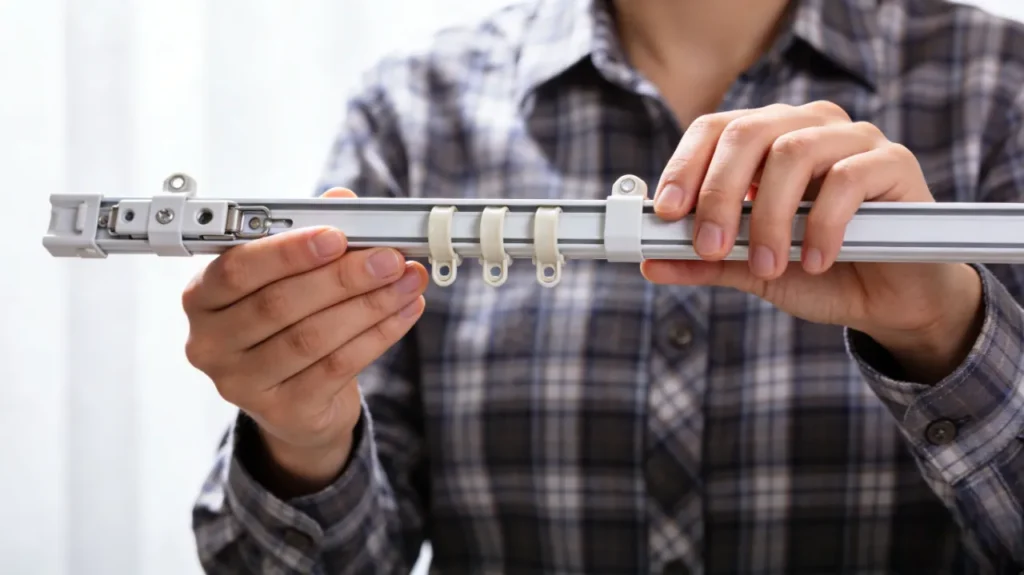
Discover why curtain tracks are widely used in residential and commercial projects. Learn their structural advantages, technical specifications, installation flexibility, and why contractors and B2B buyers prefer curtain track systems for long-term performance and scalability.
Introduction:The reason why Curtain Tracks have become a “project-level standard”
In modern construction and interior projects, curtain tracks are no longer an optional accessory. They have become a standard curtain hanging system across residential developments, hotels, offices, hospitals, and large commercial spaces.
For B2B buyers—such as contractors, developers, distributors, and project procurement managers—the choice of curtain track systems directly affects installation efficiency, long-term maintenance costs, and overall project quality.
This raises a common question in procurement and design stages:
Why are curtain tracks so widely used instead of traditional curtain rods?
The answer lies in engineering structure, system scalability, and lifecycle performance, not aesthetics alone.
Curtain Track vs. Curtain Rod: Fundamental Structural Differences
1. Load Distribution and Structural Stability
Curtain tracks distribute curtain weight along the entire rail, rather than concentrating load on two wall-mounted brackets.
Technical comparison:
| Parameter | Curtain Track | Curtain Rod |
|---|---|---|
| Load distribution | Continuous | Point-based |
| Max recommended load | 30–60 kg (heavy-duty models) | 10–20 kg |
| Deflection risk | Very low | Medium–high |
| Long-span support | Excellent | Limited |
For wide windows, floor-to-ceiling curtains, or heavy fabrics, tracks offer significantly better structural reliability.
2. Installation Adaptability in Projects
Curtain tracks support:
- Ceiling-mounted installation
- Wall-mounted installation
- Recessed (hidden) installation
- Curved and bay window layouts
This makes them ideal for:
- Hotel rooms
- Office partitions
- Hospitals and healthcare facilities
- Large residential developments
From a contractor’s perspective, one track system can solve multiple installation scenarios, reducing SKU complexity.
Why Curtain Tracks Are Preferred in Commercial and B2B Projects
1. Standardization and Scalability
Curtain track systems are designed for modular production and standardized installation, which is critical for B2B projects.
Common technical standards include:
- Rail lengths: 3m / 4m / 5.8m (customizable)
- Track thickness: 1.2–2.0 mm aluminum alloy
- Surface finish: anodized / powder-coated
- Operating noise: ≤30 dB with quality rollers
This allows:
- Bulk manufacturing
- Faster on-site installation
- Easier replacement and maintenance
2. Compatibility with Automation and Smart Systems
Modern curtain tracks are widely used because they are compatible with motorized systems.
Typical applications:
- Smart hotels
- Office automation
- High-end residential projects
Key technical parameters:
- Motor torque: 1.2–2.0 Nm
- Maximum curtain weight: up to 50 kg
- Control options: wall switch / remote / smart home system
Curtain rods rarely offer this level of automation compatibility.
Operational Advantages in Daily Use
1. Smooth Operation and Reduced Wear
High-quality curtain tracks use:
- Nylon or POM rollers
- Precision extrusion rails
- Anti-friction groove design
This results in:
- Smoother sliding
- Lower operational noise
- Reduced fabric wear over time
For B2B buyers, this translates to lower after-sales complaints and longer service life.
2. Long-Term Cost Efficiency
Although curtain tracks may have a slightly higher initial cost than basic rods, their total cost of ownership (TCO) is lower.
Reasons:
- Fewer replacements
- Less maintenance
- Reduced installation failures
This is a key reason why curtain tracks are widely used in large-scale and repeat projects.
Design Flexibility Without Structural Compromise
Curtain tracks allow:
- Hidden installation for minimalist interiors
- Multi-layer systems (sheer + blackout)
- Continuous curved designs
This flexibility is particularly important in:
- Architectural design projects
- Custom interior solutions
- Hospitality branding consistency
Designers prefer curtain tracks because they do not impose structural limitations on layout decisions.
Compliance, Safety, and Industry Standards
In commercial environments, safety and compliance are critical.
Curtain tracks can be manufactured to meet:
- Fire resistance standards
- Corrosion resistance requirements
- Load safety factors (≥2.0 recommended)
For hospitals and public buildings, curtain tracks are often specified due to:
- Hygiene-friendly surfaces
- Stable ceiling mounting
- Secure load-bearing capacity
Typical B2B Application Scenarios
Curtain tracks are widely used in:
- Hotels and resorts
- Office buildings
- Hospitals and clinics
- Student housing and dormitories
- Commercial showrooms
- Large residential developments
In most tender documents, curtain tracks are specified as a default solution, not an upgrade.
Conclusion:Why Curtain Tracks Continue to Dominate the Market
Curtain tracks are widely used because they offer structural reliability, installation flexibility, long-term durability, and system scalability—all critical factors for B2B buyers and project-based procurement.
Compared to traditional curtain rods, curtain track systems:
- Handle heavier loads
- Adapt to complex layouts
- Support automation
- Reduce lifecycle costs
For contractors, developers, and distributors, curtain tracks are not just a curtain hanging solution—they are a project-ready system designed for efficiency, consistency, and long-term performance.