

Introduction
Accurate measurement is the foundation of a professional curtain rod installation—particularly for commercial projects where consistency, durability, and visual precision must meet strict procurement and design standards. Whether you are supplying hardware for hotels, office buildings, retail shops, multi‑unit housing, or healthcare facilities, knowing how to measure for a curtain rod ensures proper load distribution, optimized light coverage, and long‑term structural reliability.
This guide delivers a fully optimized B2B technical resource aligned with EEAT principles, integrating industry‑specific parameters, commercial installation best practices, and long‑tail keywords geared toward procurement managers, interior contractors, wholesalers, and facility planners.
Why Accurate Measurement Matters in Commercial Curtain Rod Projects
In commercial environments, curtain rods serve not only decorative purposes but critical functional needs such as privacy control, acoustic management, and sunlight regulation.
Key B2B Considerations
- Load calculations for heavy curtains, blackout fabrics, or oversized windows
- Standardization across multiple units or rooms to reduce installation variance
- Material compatibility for metal, drywall, masonry, or reinforced structures
- Compliance with safety and building hardware guidelines (e.g., EN 13120)
Accurate measurement prevents misalignment, sagging, bracket failure, and costly rework.
Step-by-Step: How to Measure for a Curtain Rod
Below is the industry-approved measurement process tailored for B2B projects.
1. Measure the Window Width
Start by measuring the net width of the window frame from edge to edge.
Technical Notes
- Use a Class II tape measure for ±0.7 mm accuracy.
- For oversized commercial windows, use a laser distance measurer (Class 2M).
Calculation
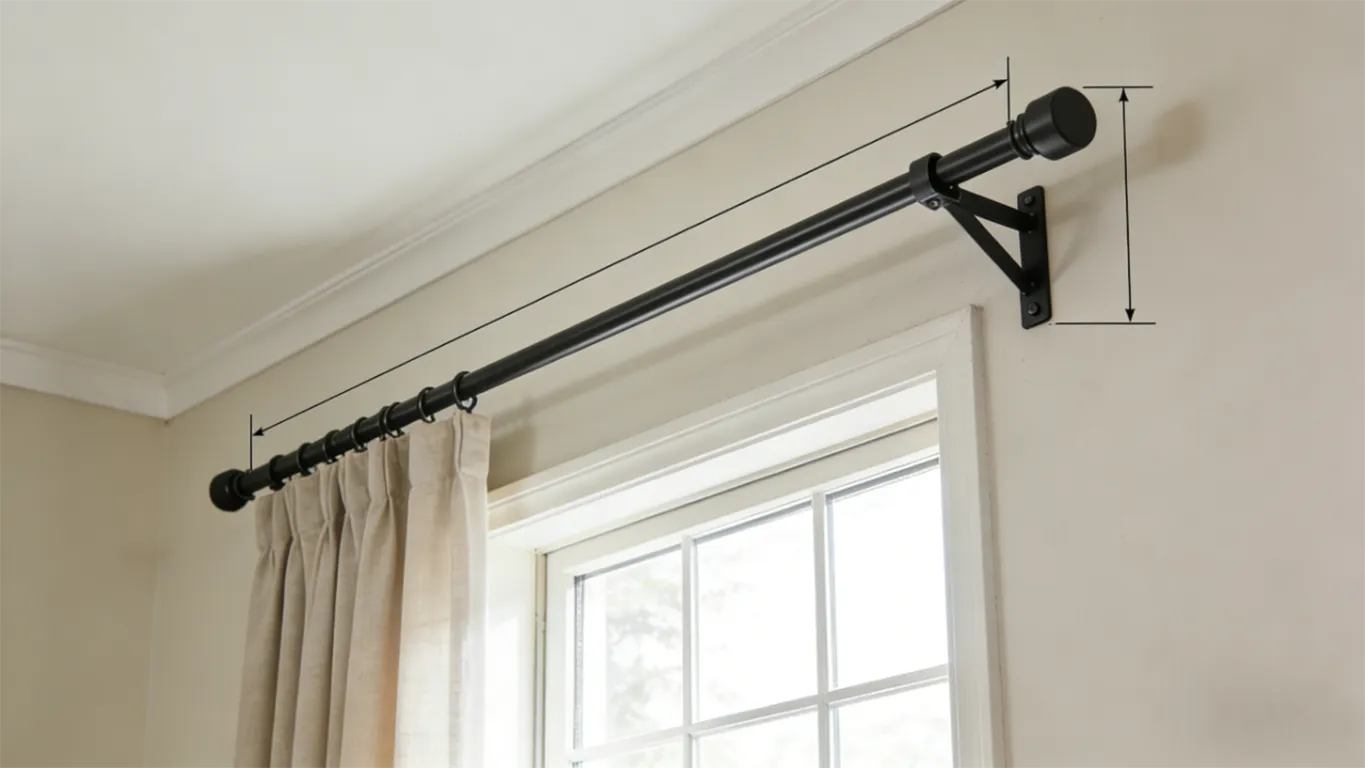
Rod Width = Window Width + Recommended Extension (per side)
Typical commercial extensions:
- 150–200 mm per side for hotels and offices
- 200–300 mm per side for blackout applications
- 100–150 mm per side for retail or decorative installations
2. Determine the Rod Placement Height
The installation height directly affects visual proportion and functionality.
Common B2B Guidelines
- 100–200 mm above frame for standard commercial spaces
- 200–350 mm above for luxury hotel rooms to enhance perceived ceiling height
- For very tall windows (>3.2 m), use 15–20% of window height as placement offset
Technical Tips
- Verify clearance between rod position and ceiling fixtures or HVAC elements.
- Maintain a minimum 30 mm header-to-rod gap for pinch pleat and S‑fold curtains.
3. Select Rod Diameter Based on Curtain Weight
Commercial environments often require reinforced rods.
Technical Load Chart (Typical Industry Ranges)
| Curtain Type | Weight (kg/m) | Recommended Rod Diameter |
|---|---|---|
| Sheer fabric | 0.3–0.6 kg/m | Ø 22–25 mm |
| Standard drapes | 0.8–1.2 kg/m | Ø 25–28 mm |
| Blackout curtains | 1.4–2.3 kg/m | Ø 28–32 mm |
| Heavy commercial fabric | 2.5–3.8 kg/m | Ø 32–38 mm reinforced |
Include a 20–30% safety margin per B2B engineering practices.
4. Calculate Bracket Spacing and Quantity
Incorrect bracket spacing leads to rod sagging and load failure.
Commercial Standard
- Maximum span per bracket: 1.6–2.0 m depending on rod material (steel vs aluminum)
- For rods over 3.2 m, add a center support bracket
- For heavyweight blackout installations: support every 1.2–1.4 m
Mounting Surface Considerations
- Concrete: use 6–8 mm expansion anchors
- Drywall: use M5 metal cavity anchors
- Wood: use #8 wood screws (32–38 mm)
5. Determine Rod Overhang and Finial Clearance
For commercial curtains, ensure the rod extends sufficiently beyond the stacking area.
Standard Overhang Calculations
- Required stack-back: 20–28% of total curtain width
- Finial clearance: 40–70 mm depending on decorative or minimalist style
- Avoid obstruction from nearby walls, pillars, sprinklers, or cabinetry
6. Double-Window or Multi-Panel Installations
Large commercial spaces often use continuous rod systems.
Technical Guidelines
- Use splice connectors for rods over 3.2–3.5 m
- Ensure a maximum misalignment tolerance of ≤1.5 mm across joints
- For multi-bay windows, maintain uniform rod height ±2 mm
Conclusion
Accurate curtain rod measurement is essential for professional, safe, and aesthetically consistent commercial installations. By assessing window dimensions, selecting the correct rod diameter, planning bracket spacing, and accounting for load distribution, B2B decision‑makers can ensure reliable long‑term performance across diverse environments. Whether equipping hotels, office buildings, retail spaces, or large residential projects, following these technical guidelines ensures your curtain rod system is stable, functional, and visually aligned with architectural expectations.