

Introduction: Why Curtain Track Systems Matter in Commercial Projects
In commercial environments such as hotels, hospitals, offices, shopping malls, schools, and public facilities, curtain track systems are not decorative accessories—they are functional building components.
A poorly specified curtain track can lead to:
- Premature failure under frequent use
- Noise complaints in hospitality or healthcare settings
- Safety risks due to insufficient load ratings
- Increased maintenance and replacement costs
For B2B buyers, the selection criteria extend far beyond aesthetics. Decision-makers must evaluate technical performance, compliance standards, scalability, and total cost of ownership.
This article explains how to choose the right curtain track system for commercial projects, focusing on professional specifications, niche technical parameters, and real-world use cases.
Understanding Commercial Curtain Track Systems
What Is a Commercial Curtain Track System?
A commercial curtain track system is a mechanical rail system designed to support, guide, and operate curtains or drapery in high-traffic environments. Unlike residential systems, commercial tracks are engineered for:
- Higher load capacity
- Continuous daily operation
- Stricter safety and fire regulations
- Longer service life (10–20 years)
Common Commercial Applications
- Hotels & Resorts – guest rooms, conference halls, ballrooms
- Healthcare Facilities – privacy curtains, ICU partitions
- Office Buildings – meeting rooms, acoustic zoning
- Retail & Shopping Malls – storefronts, fitting rooms
- Educational Institutions – auditoriums, classrooms
Key Factors When Choosing a Curtain Track System for Commercial Use
1. Load Capacity and Weight Rating (Critical for B2B Buyers)
One of the most overlooked yet crucial parameters is maximum load per meter.
| Track Type | Typical Load Capacity |
|---|---|
| Light-duty aluminum track | 8–12 kg/m |
| Medium-duty commercial track | 15–30 kg/m |
| Heavy-duty steel-reinforced track | 40–60 kg/m |
Professional tip:
Always calculate:
- Curtain fabric weight (gsm × width × height)
- Added accessories (liners, blackout layers, wave tape)
- Safety margin of ≥20%
This ensures compliance with commercial liability and safety standards.
2. Material Selection: Aluminum vs Steel vs Hybrid Tracks
Aluminum Curtain Tracks
- Corrosion-resistant
- Lightweight
- Ideal for hotels, offices, retail
Technical grade to look for:
- 6063-T5 or 6061-T6 anodized aluminum
Steel or Reinforced Tracks
- Higher structural strength
- Suitable for theaters, hospitals, industrial spaces
- Typically powder-coated or zinc-plated
Hybrid Systems
- Aluminum rail with steel internal core
- Best balance between weight and durability
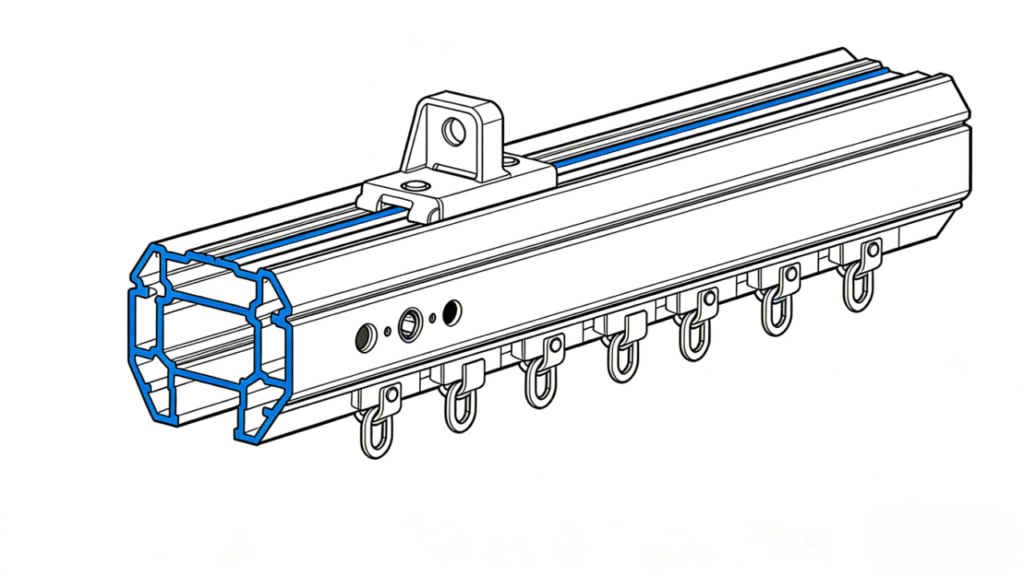
3. Track Profile Design and Cross-Section Geometry
Professional buyers should request track cross-section drawings.
Key parameters include:
- Rail wall thickness (≥1.2 mm recommended)
- Slot width tolerance (±0.2 mm)
- Roller clearance height
These factors directly affect:
- Smoothness of operation
- Noise control
- Wear resistance
4. Manual vs Motorized Curtain Track Systems
Manual Systems
Best for:
- Budget-controlled projects
- Low-frequency operation
- Smaller window spans
Key specs:
- Roller friction coefficient ≤0.04
- Ball-bearing or self-lubricating nylon runners
Motorized Systems
Ideal for:
- Hotels
- Conference centers
- Smart buildings
Advanced features:
- Load rating: 50–100 kg per motor
- Noise level: ≤35 dB
- Integration with BMS, KNX, Zigbee, or Wi-Fi
- Emergency manual override
5. Fire Safety and Compliance Standards (EEAT-Critical)
Commercial projects must comply with local and international regulations.
Common standards include:
- NFPA 701 (flame resistance – US)
- EN 13501-1 (EU fire classification)
- BS 5867 (UK curtain safety)
- ASTM E84 (surface burning characteristics)
Ensure the track system:
- Uses non-combustible materials
- Maintains structural integrity at elevated temperatures
- Supports fire-retardant curtain fabrics
6. Installation Environment and Mounting Methods
Ceiling-Mounted Tracks
- Clean visual appearance
- Ideal for hotels and offices
- Requires precise ceiling substrate analysis
Wall-Mounted Tracks
- More flexible
- Suitable for retrofitting projects
Recessed / Concealed Tracks
- High-end commercial interiors
- Requires coordination during early construction phase
Professional note:
Always confirm:
- Anchor type (concrete, steel, gypsum)
- Fastener pull-out resistance (≥3× static load)
7. Noise Control and Acoustic Performance
In hospitality and healthcare environments, noise matters.
Look for:
- Soft-running polymer rollers
- Anti-vibration inserts
- Low-noise glide (<25 dB at 1 m distance)
Noise complaints often result in post-installation replacements, increasing lifecycle costs.
8. Maintenance, Durability, and Lifecycle Cost
B2B buyers should evaluate total cost of ownership (TCO) rather than unit price.
Key metrics:
- Expected service life: 10–20 years
- Maintenance interval: ≥12 months
- Spare part availability: ≥10 years
High-quality commercial tracks reduce:
- Downtime
- Replacement labor
- Guest or occupant complaints
Long-Tail B2B Keywords Naturally Targeted
- commercial curtain track system specification
- heavy duty curtain tracks for hotels
- hospital privacy curtain track system
- motorized curtain track for commercial buildings
- aluminum curtain track load capacity
- fire rated curtain track system
Conclusion: Making the Right Curtain Track Decision for Commercial Projects
Choosing the right curtain track system for commercial projects requires a technical, compliance-driven, and lifecycle-focused approach. By evaluating load capacity, material grade, fire standards, installation conditions, and long-term maintenance, B2B buyers can significantly reduce operational risk and cost.
For architects, contractors, and procurement teams, a well-specified curtain track system is not just a component—it is a long-term performance investment that directly affects safety, user experience, and project credibility.