

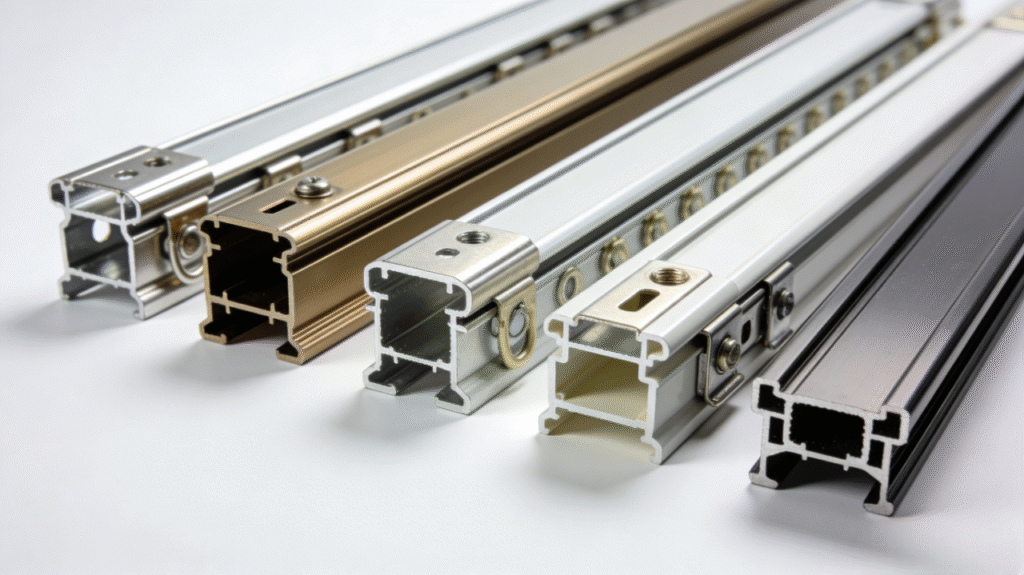
Why Curtain Track Selection Matters for B2B Buyers
For B2B buyers, choosing the right curtain track is not simply an aesthetic decision—it directly impacts installation efficiency, long-term durability, maintenance costs, and end-user satisfaction.
In commercial environments such as hotels, serviced apartments, office buildings, hospitals, and large residential developments, curtain systems are installed in bulk. A wrong choice in track type can lead to:
- Increased after-sales maintenance
- Higher failure rates under frequent use
- Installation delays and cost overruns
- Poor integration with smart building systems
Understanding the differences between straight, curved, and motorized curtain tracks allows buyers, contractors, and specifiers to match the right system to the right application—maximizing ROI and project reliability.
Overview of the Three Main Curtain Track Types
Before diving into technical comparisons, let’s define the three most common curtain track categories used in B2B procurement.
1. Straight Curtain Track
Designed for linear window or wall installations.
2. Curved Curtain Track
Custom-bent tracks for bay windows, corner windows, or architectural curves.
3. Motorized Curtain Track
Electrically driven systems integrated with automation or smart control platforms.
Each type serves distinct functional and commercial needs, which we’ll explore in detail below.
Straight Curtain Track: Cost-Efficient and Scalable
What Is a Straight Curtain Track?
A straight curtain track is a linear aluminum or steel rail system designed for standard windows or wall-mounted curtain installations. It is the most widely used option in bulk commercial projects.
Key Technical Specifications (B2B Reference)
| Parameter | Typical Range |
|---|---|
| Material | Extruded aluminum alloy 6063-T5 |
| Load capacity | 6–10 kg per meter |
| Track thickness | 1.0–1.4 mm |
| Maximum single length | 6–7 meters |
| Mounting options | Ceiling-mounted / wall-mounted |
| Compatible carriers | Plastic or stainless steel rollers |
Common B2B Applications
- Hotel guest rooms
- Office buildings
- Rental apartments
- Student housing projects
- Budget hospitality chains
Advantages for B2B Buyers
- Lowest unit cost among all track types
- Fast installation for large-scale projects
- Easy replacement and standardized spare parts
- Ideal for OEM customization (length, color, branding)
Limitations
- Not suitable for curved or irregular window shapes
- Limited design flexibility in high-end architectural spaces
Best Use Case
If your project prioritizes cost control, speed, and uniformity, straight curtain tracks are the most practical choice.
Curved Curtain Track: Precision for Architectural Design
What Is a Curved Curtain Track?
Curved curtain tracks are custom-shaped rails designed to follow non-linear window structures such as bay windows, corner glazing, or curved walls.
These tracks are usually factory-bent using CNC bending or cold-forming technology to ensure smooth curtain movement.
Key Technical Specifications
| Parameter | Typical Range |
|---|---|
| Bending radius | ≥300 mm (depending on profile) |
| Material | High-strength aluminum alloy |
| Load capacity | 5–8 kg per meter |
| Tolerance | ±2 mm over full length |
| Surface finish | Powder coating / anodized |
Common B2B Applications
- Luxury hotels and resorts
- High-end residential developments
- Villas and penthouses
- Commercial display spaces
Advantages for B2B Buyers
- Custom-fit architectural solutions
- Enhances visual continuity and design value
- Compatible with wave curtains and layered drapery systems
- Adds premium differentiation to property projects
Limitations
- Higher tooling and customization costs
- Longer production lead time
- More complex installation requirements
Best Use Case
Curved curtain tracks are ideal for projects where design accuracy and premium aesthetics outweigh cost considerations.
Motorized Curtain Track: Automation and Smart Integration
What Is a Motorized Curtain Track?
A motorized curtain track integrates an electric drive motor, allowing curtains to open and close automatically via:
- Remote control
- Wall switch
- Smart home systems
- Building management systems (BMS)
Key Technical Specifications
| Parameter | Typical Range |
|---|---|
| Motor torque | 1.2–2.0 Nm |
| Max load | 30–60 kg total |
| Noise level | ≤35 dB |
| Power supply | AC 110–240V or DC 24V |
| Control protocols | Zigbee, WiFi, RS485, Dry Contact |
| Track length | Up to 12 meters (jointed) |
Common B2B Applications
- Smart hotels
- Luxury apartments
- Office automation projects
- Healthcare and senior living facilities
Advantages for B2B Buyers
- Enhances user experience and automation
- Increases property value and differentiation
- Supports centralized control for large projects
- Reduces manual wear and tear
Limitations
- Higher upfront investment
- Requires electrical planning and commissioning
- Motor replacement cost must be considered
Best Use Case
Motorized curtain tracks are best suited for smart building projects where automation, comfort, and branding are key selling points.
Straight vs Curved vs Motorized: B2B Comparison Table
| Feature | Straight | Curved | Motorized |
|---|---|---|---|
| Cost level | Low | Medium–High | High |
| Customization | Low | High | Medium |
| Installation speed | Fast | Medium | Slow |
| Automation | No | No | Yes |
| Maintenance | Minimal | Low | Moderate |
| Ideal buyers | Wholesalers, contractors | Developers, designers | Smart project integrators |
Key Factors B2B Buyers Should Consider
1. Project Type and Scale
Bulk residential projects favor straight tracks, while landmark buildings may justify curved or motorized systems.
2. Budget and Lifecycle Cost
Motorized tracks have higher upfront costs but can reduce manual damage over time.
3. Installation Environment
Ceiling structure, power access, and tolerance control all influence track choice.
4. End-User Expectations
Hotels and premium residences increasingly expect smart curtain solutions.
Conclusion: Choosing the Right Curtain Track for Long-Term Value
Choosing the right curtain track depends on project scale, architectural design, automation needs, and budget structure.
- Straight curtain tracks offer unbeatable efficiency and cost control for large-volume projects.
- Curved curtain tracks deliver precision and premium aesthetics for architect-driven spaces.
- Motorized curtain tracks unlock automation, comfort, and smart integration for modern buildings.
For B2B buyers, the optimal choice is not about trend—but about matching technical performance with real-world usage scenarios to ensure durability, efficiency, and long-term value.