

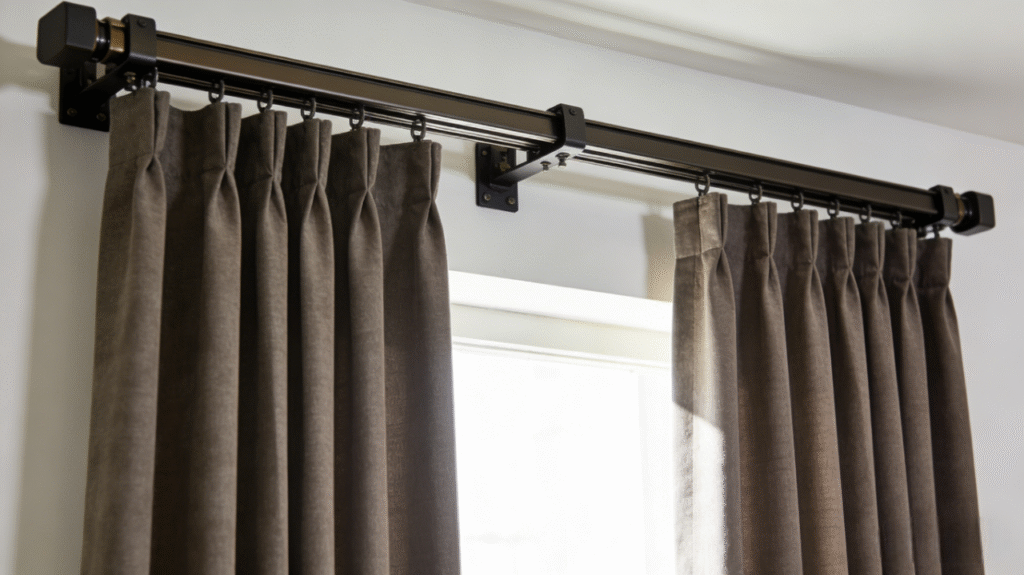
Why Curtain Track Load Capacity Matters for Heavy Curtains
For B2B buyers, curtain weight capacity is not an abstract number—it directly affects system safety, durability, and long-term maintenance cost.
In projects such as:
- Hotels and serviced apartments
- Modern residential developments
- Office buildings with blackout requirements
- Hospitals and public facilities
Curtains are often heavier, wider, and used more frequently than in typical residential settings.
Selecting a curtain track without properly evaluating load capacity can lead to:
- Track deformation or sagging
- Roller failure and uneven movement
- Increased noise and friction
- Premature system replacement
This guide explains how much weight a curtain track can hold, what technical parameters truly matter, and how to choose the right curtain track for heavy curtains from a professional B2B perspective.
What Determines How Much Weight a Curtain Track Can Hold?
Curtain track load capacity is determined by system design, not just material thickness. The following factors work together:
1. Track Material and Profile Design
2. Bracket Density and Mounting Method
3. Carrier / Roller System
4. Installation Accuracy
5. Curtain Fabric Type and Distribution
Ignoring any one of these factors can significantly reduce real-world load performance.
Standard Curtain Track Load Capacity Explained
Typical Load Ratings (Industry Reference)
| Curtain Track Type | Load Capacity |
|---|---|
| Light-duty residential track | 3–5 kg per meter |
| Standard commercial track | 6–8 kg per meter |
| Heavy-duty curtain track | 8–12 kg per meter |
| Motorized curtain track | 30–60 kg total load |
Important: Load capacity is usually specified per meter, not total curtain weight.
Example Calculation (Common Mistake)
- Curtain width: 4 meters
- Curtain weight: 40 kg total
- Actual load: 10 kg per meter
This setup requires a heavy-duty or motorized curtain track, not a standard residential track.
How Heavy Are “Heavy Curtains” in Real Projects?
Many buyers underestimate curtain weight, especially for blackout or layered systems.
Common Curtain Fabric Weights
| Curtain Type | Approx. Weight |
|---|---|
| Sheer curtain | 0.8–1.5 kg/m |
| Standard fabric curtain | 2–4 kg/m |
| Blackout curtain | 5–8 kg/m |
| Hotel-grade blackout | 7–10 kg/m |
| Double-layer (sheer + blackout) | 8–12 kg/m |
In hotels, it’s common for a single window curtain system to exceed 40–60 kg total weight.
Key Technical Parameters That Affect Load Capacity (Often Overlooked)
1. Aluminum Thickness and Alloy
- Recommended alloy: 6063-T5 aluminum
- Minimum thickness for heavy curtains: ≥1.2 mm
- Premium heavy-duty tracks: 1.4–1.6 mm
Thin aluminum (<1.0 mm) will deform under long-term load.
2. Track Profile Geometry
Not all tracks with the same thickness perform equally.
High-load tracks feature:
- Reinforced top ribs
- Box or double-channel profiles
- Reduced vertical deflection under load
Deflection tolerance should be:
- ≤2 mm per meter under full load
3. Bracket Spacing (Critical)
| Curtain Weight | Bracket Spacing |
|---|---|
| ≤6 kg/m | 500–600 mm |
| 6–8 kg/m | 400–500 mm |
| ≥8 kg/m | 300–400 mm |
Incorrect spacing is the #1 cause of track sagging.
4. Mounting Method: Ceiling vs Wall
Ceiling-mounted tracks distribute load vertically and support heavier curtains more safely.
Wall-mounted tracks:
- Create cantilever stress
- Require reinforced walls
- Are less suitable for heavy blackout curtains
For heavy curtains, ceiling mounting is strongly recommended.
Rollers and Carriers: Small Parts, Big Impact
Even the strongest track will fail if the carrier system is underspecified.
Recommended Carrier Specifications
- Material: reinforced polymer or stainless steel axle
- Wheel diameter: ≥10 mm
- Load rating: ≥8 kg per carrier
Carrier Spacing
- Standard curtains: 80–100 mm
- Heavy curtains: 60–80 mm
Dense spacing ensures even load distribution and smooth movement.
Motorized Curtain Tracks for Heavy Curtains
When curtain systems exceed 40–50 kg total weight, motorized tracks are often the safest and most durable solution.
Typical Motorized Track Parameters
| Parameter | Standard |
|---|---|
| Max load | 30–60 kg |
| Motor torque | 1.2–2.0 Nm |
| Noise level | ≤35 dB |
| Power supply | AC 110–240V / DC 24V |
| Max single track length | 8–12 m |
Motorized systems reduce:
- Manual pulling stress
- Uneven force on tracks
- Fabric and carrier wear
Common B2B Mistakes When Choosing Tracks for Heavy Curtains
Mistake 1: Choosing Based on Appearance Only
Decorative tracks may not meet load requirements.
Mistake 2: Ignoring Curtain Accessories
Tiebacks, interlinings, and linings add significant weight.
Mistake 3: Underestimating Long-Term Use
Hotel curtains may be operated 10–20 times per day.
Mistake 4: Using Residential-Grade Tracks in Commercial Projects
This leads to early failure and warranty claims.
How to Choose the Right Curtain Track for Heavy Curtains (Step-by-Step)
Step 1: Calculate Total Curtain Weight
Include all layers and accessories.
Step 2: Convert to Load per Meter
Total weight ÷ track length.
Step 3: Select Track Rated 20–30% Above Actual Load
This safety margin accounts for dynamic forces.
Step 4: Specify Bracket Spacing and Carrier Density
Do not leave this to installers.
Step 5: Decide Manual vs Motorized
For ≥40 kg systems, motorized is usually more cost-effective long-term.
Conclusion: Choosing the Right Curtain Track for Heavy Curtains
So, how much weight can a curtain track hold? The answer depends on track design, material quality, mounting method, and installation accuracy.
For heavy curtains—especially blackout, layered, or hotel-grade systems—standard tracks are often insufficient. Choosing a heavy-duty or motorized curtain track, combined with proper bracket spacing and carrier density, ensures long-term performance, safety, and reduced maintenance costs.
For B2B buyers, selecting the right curtain track is not just a technical choice—it is a risk management decision that protects project quality and lifecycle value.