

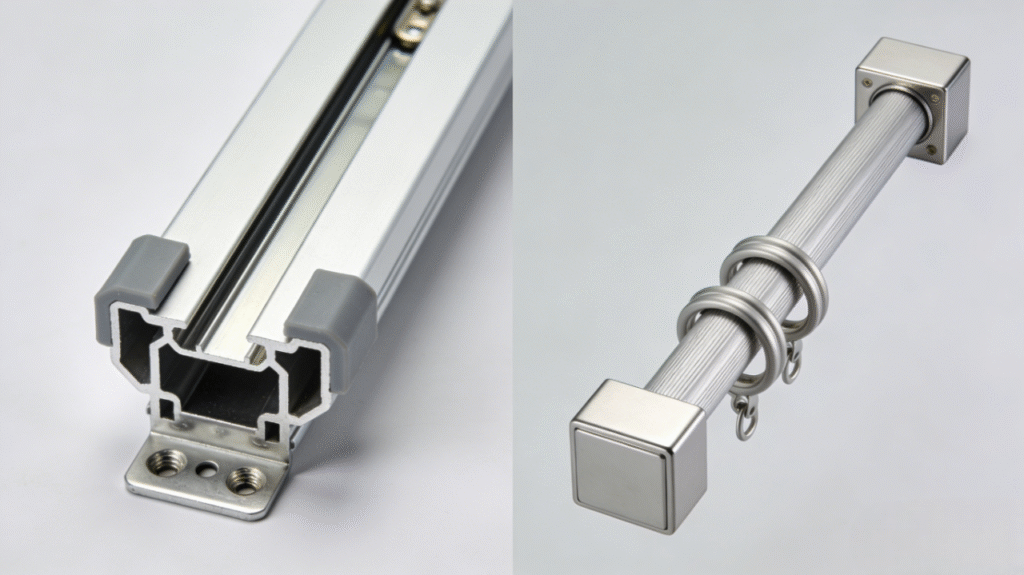
Why the Curtain Track vs Curtain Rod Debate Matters for B2B Buyers
In modern residential projects, window treatment systems are no longer decorative accessories—they are integrated architectural components that affect usability, durability, and interior design consistency.
For developers, architects, wholesalers, and project contractors, choosing between a curtain track system and a curtain rod system directly impacts:
- Installation efficiency across multiple units
- Long-term maintenance and replacement costs
- Compatibility with modern interior design trends
- Standardization for bulk procurement
Although curtain rods remain popular in traditional residential settings, curtain tracks are increasingly specified in modern homes, especially in large-scale developments and mid-to-high-end projects.
This article compares curtain tracks vs curtain rods from a professional B2B perspective, focusing on performance, technical parameters, and commercial suitability.
Basic Definitions: Curtain Track vs Curtain Rod
What Is a Curtain Track?
A curtain track is a rail-based system, typically made of aluminum or steel, where curtains glide using carriers or rollers concealed inside the track.
Common features:
- Ceiling-mounted or wall-mounted
- Compatible with wave curtains, blackout curtains, and motorized systems
- Designed for smooth, low-friction operation
What Is a Curtain Rod?
A curtain rod is a visible pole system, usually mounted on brackets, where curtains hang via rings or grommets.
Common features:
- Wall-mounted installation
- Decorative finials
- Manual operation only
- Limited load capacity compared to tracks
Design Compatibility in Modern Homes
Curtain Track: Minimalist and Integrated
Modern home design prioritizes clean lines, concealed hardware, and functional minimalism. Curtain tracks align naturally with these principles.
Advantages:
- Hidden installation inside ceilings or pelmets
- Seamless wall-to-wall coverage
- No visual interruption from hardware
- Ideal for floor-to-ceiling curtains
Curtain tracks are widely used in:
- Modern apartments
- Smart homes
- Minimalist and Scandinavian interiors
- Developer-led residential projects
Curtain Rod: Decorative but Visually Dominant
Curtain rods emphasize decorative hardware, which can conflict with modern minimalist interiors.
Limitations in modern homes:
- Visible brackets and finials
- Interrupted curtain flow
- Difficult to integrate with recessed ceilings
Curtain rods are more suitable for:
- Traditional or classic interior styles
- Renovation projects with exposed walls
- Boutique residential applications
Structural Performance and Load Capacity
Load Capacity Comparison (Technical View)
| Parameter | Curtain Track | Curtain Rod |
|---|---|---|
| Load rating | 6–12 kg per meter | 3–6 kg per meter |
| Maximum span | 6–12 m (jointed) | 2–3 m |
| Deflection tolerance | ≤2 mm per meter | ≥5 mm per meter |
| Heavy blackout support | Yes | Limited |
Curtain tracks distribute load evenly across multiple brackets, while curtain rods concentrate load on wall-mounted brackets, increasing deformation risk.
Long-Term Durability
For B2B projects with frequent daily use (e.g. rental apartments):
- Curtain tracks show lower wear on fabric and hardware
- Curtain rods experience ring abrasion and bracket loosening
This difference significantly affects warranty claims and maintenance cycles.
Installation Efficiency and Standardization
Curtain Track Installation (B2B Advantage)
Curtain tracks are highly standardized and suitable for bulk installation.
Key parameters:
- Bracket spacing: 500–600 mm
- Installation tolerance: ±2 mm
- Compatible with prefabricated ceilings
Advantages:
- Faster installation per unit
- Fewer SKU variations
- Easier quality control across projects
Curtain Rod Installation (Less Scalable)
Curtain rod installation is more variable:
- Wall material dependency
- Decorative alignment requirements
- Higher installation error rate
This makes curtain rods less efficient for large-scale developments.
Functional Flexibility and System Compatibility
Curtain Track Systems
Curtain tracks support:
- Single-layer and double-layer curtains
- Wave curtain systems
- Curved and corner windows
- Motorized and smart control integration
Technical compatibility:
- Zigbee / WiFi / RS485 (motorized tracks)
- Load testing up to 60 kg (motorized systems)
Curtain Rod Systems
Curtain rods are limited to:
- Single-layer curtains
- Straight windows only
- Manual operation
They are generally incompatible with:
- Curved walls
- Motorized operation
- Ceiling-recessed designs
Cost Structure: Initial vs Lifecycle Cost
Initial Procurement Cost
- Curtain rods: lower unit price
- Curtain tracks: slightly higher material cost
However, initial cost does not reflect total project cost.
Lifecycle Cost (B2B Reality)
Curtain tracks reduce:
- Installation time
- Fabric damage
- Hardware replacement frequency
For multi-unit projects, curtain tracks often deliver lower total lifecycle cost despite higher upfront pricing.
Common B2B Use Cases: Which System Fits Better?
Curtain Tracks Are Better For:
- Modern apartments
- Developer-led housing projects
- Smart homes
- Hotels and serviced residences
- Projects requiring blackout or wave curtains
Curtain Rods Are Better For:
- Traditional-style homes
- Small-scale renovations
- Decorative-focused interiors
- Low-frequency use environments
Conclusion: Which Is Better for Modern Homes?
For modern homes, especially in B2B-driven residential projects, curtain tracks are generally the superior choice.
They offer better load distribution, cleaner aesthetics, higher scalability, and stronger compatibility with modern design and smart systems. Curtain rods still have a place in decorative or traditional settings, but their limitations make them less suitable for contemporary, large-scale developments.
For developers, designers, and project buyers, choosing curtain tracks over curtain rods is not just a design preference—it is a strategic decision that improves performance, consistency, and long-term value.