

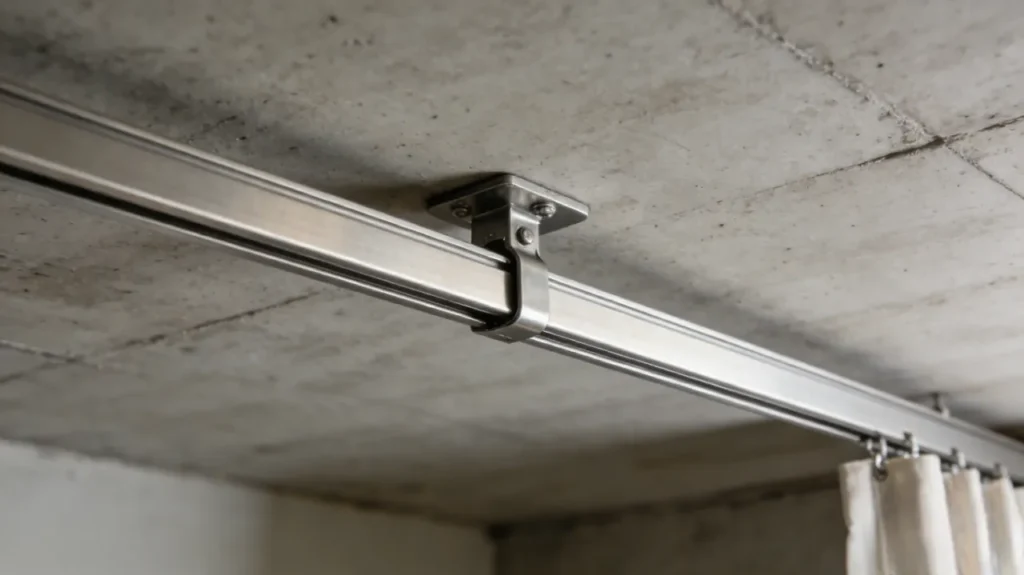
Introduction: Why Installation Method Matters for Curtain Track Projects
In commercial and residential projects alike, curtain tracks are often treated as a minor accessory. However, for B2B buyers, contractors, and project managers, the installation method of a curtain track—top mounting or side mounting—has a direct impact on:
- Structural safety
- Load-bearing performance
- Installation cost and efficiency
- Maintenance and replacement cycles
- End-user experience
Incorrect installation choices can lead to track deformation, noise complaints, curtain sagging, or even ceiling damage, especially in hotel, apartment, or large-scale residential projects.
This guide provides a technical and application-driven comparison of top-mounted and side-mounted curtain tracks, focusing on real-world B2B installation scenarios rather than retail-level explanations.
Understanding Curtain Track Installation Methods
Before comparing performance, it is essential to define the two primary installation methods used in the curtain track industry.
What Is Top Mounting Curtain Track Installation?
Top mounting refers to installing the curtain track directly onto the ceiling, concrete slab, or suspended ceiling structure using anchors, expansion bolts, or steel fixings.
Common applications:
- Hotel rooms
- Apartments with curtain boxes
- Commercial offices
- High-end residential projects
What Is Side Mounting Curtain Track Installation?
Side mounting (also known as wall mounting) involves fixing the curtain track onto a vertical surface above the window using brackets or wall-mounted supports.
Common applications:
- Renovation projects
- Buildings without ceiling reinforcement
- Industrial or utility spaces
- Projects with exposed structural design
Structural and Load-Bearing Performance Comparison
Load Capacity: A Critical B2B Decision Factor
From a procurement and engineering standpoint, load-bearing performance is often the first concern.
Top Mounting Load Performance
- Load distributed vertically into slab or beam
- Suitable for heavy curtains (8–15 kg per linear meter)
- Ideal for blackout curtains, acoustic curtains, and multi-layer systems
- Less stress on brackets due to direct downward force
Side Mounting Load Performance
- Load transferred horizontally to wall brackets
- Recommended load typically 5–8 kg per linear meter
- Higher torque stress on fixing points
- Requires reinforced wall materials (concrete or solid brick preferred)
B2B Insight:
For hotel or serviced apartment projects using double-layer blackout curtains, top mounting is strongly recommended to reduce long-term deformation risks.
Installation Efficiency and On-Site Labor Considerations
Top Mounting Installation Efficiency
Advantages:
- Clean alignment with ceiling structure
- Compatible with prefabricated curtain boxes
- Allows concealed track designs
Challenges:
- Requires early-stage coordination with ceiling works
- Installation height accuracy is critical
- More demanding in gypsum board ceilings without reinforcement
Side Mounting Installation Efficiency
Advantages:
- Flexible for late-stage or renovation projects
- Easier access for drilling and adjustment
- Minimal ceiling coordination required
Challenges:
- Bracket spacing must be precise (usually ≤600 mm)
- Higher risk of visible misalignment
- Additional components increase SKUs and installation time
Contractor Perspective:
For refurbishment projects with tight timelines, side mounting often reduces installation complexity, provided wall conditions are suitable.
Compatibility with Curtain Track Systems and Profiles
Not all curtain tracks are designed equally for both installation methods.
Track Profile Thickness and Installation Suitability
| Technical Parameter | Top Mounting | Side Mounting |
|---|---|---|
| Aluminum Thickness | ≥1.2 mm recommended | ≥1.4 mm recommended |
| Track Height | Low-profile preferred | Medium to high profile |
| Internal Cavity | Suitable for concealed sliders | Must support bracket fixation |
| Bending Capability | Excellent for curved tracks | Limited for curved tracks |
Small Technical Detail (Often Overlooked):
For side-mounted installations, the moment of inertia of the aluminum profile becomes more critical due to cantilever load effects.
Noise Control and Sliding Performance
Top Mounting: Optimized for Silent Operation
- Gravity-aligned slider movement
- Reduced lateral friction
- Ideal for nylon roller or stainless steel wheel systems
- Lower long-term wear on track surface
Side Mounting: Requires Higher Precision Components
- Bracket alignment affects smoothness
- Poor installation can introduce vibration noise
- Requires higher-quality rollers or ball-bearing carriers
B2B Recommendation:
If supplying to hospitality or residential developers with strict noise standards, top-mounted silent curtain tracks provide a safer specification choice.
Aesthetic and Architectural Integration
Top Mounting: Preferred for Modern Architecture
- Invisible track appearance
- Seamless integration with ceiling lines
- Compatible with curtain boxes and recessed designs
Side Mounting: Functional but Visually Present
- Track and brackets often visible
- Better suited to industrial or utility designs
- Requires consistent bracket finishing for visual uniformity
Maintenance, Replacement, and Lifecycle Cost
Top Mounting Maintenance Profile
- Less frequent adjustment required
- Replacement may involve ceiling access
- Longer service life under correct load conditions
Side Mounting Maintenance Profile
- Easier to remove and replace
- Brackets may loosen over time
- Higher maintenance frequency in high-traffic environments
Lifecycle Cost Insight:
While side mounting may reduce initial installation cost, top mounting often results in lower total cost of ownership for long-term commercial projects.
Typical B2B Application Scenarios
When to Choose Top Mounting Curtain Tracks
- Hotel and resort projects
- High-rise residential developments
- Curtain box or concealed ceiling designs
- Heavy or multi-layer curtain systems
When to Choose Side Mounting Curtain Tracks
- Renovation or retrofit projects
- Buildings without ceiling load capacity
- Industrial or temporary installations
- Budget-sensitive commercial spaces
Conclusion: Making the Right Installation Choice for B2B Projects
Choosing between top mounting and side mounting curtain tracks is not a matter of preference but a technical and commercial decision.
For projects requiring high load capacity, silent operation, long service life, and premium appearance, top mounting curtain tracks are the optimal solution.
For renovation projects, flexible installation environments, or cost-sensitive applications, side mounting curtain tracks remain a practical alternative when properly specified.
For B2B buyers, distributors, and project contractors, aligning the installation method with structural conditions, curtain weight, and lifecycle expectations is essential to delivering reliable and professional curtain track solutions.