

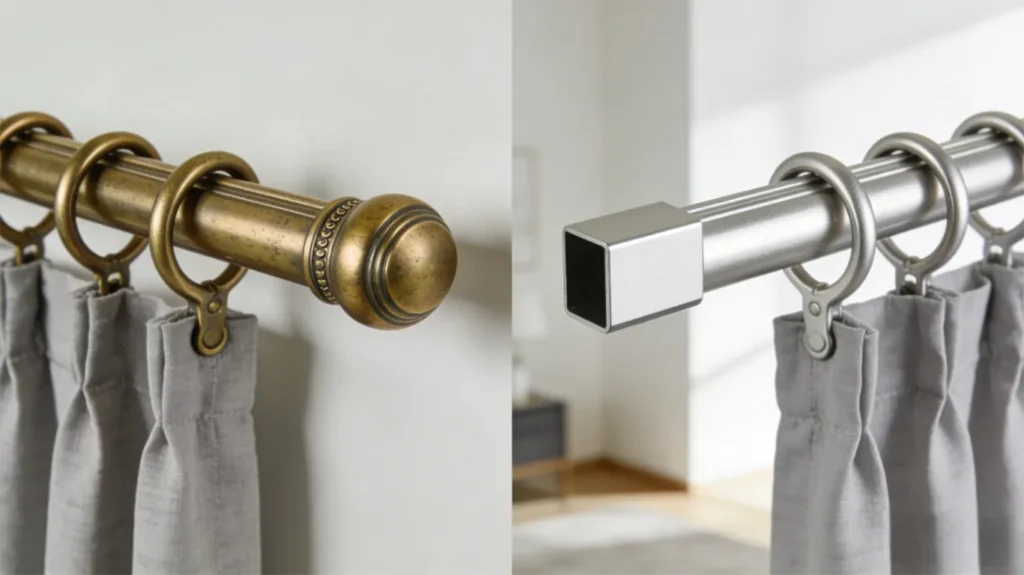
Introduction: Why Material Choice Matters in Commercial Curtain Rod Projects
For commercial buyers, contract suppliers, hospitality groups, and interior project managers, choosing between a brass curtain rod and an aluminum curtain rod is not merely a design decision. It directly affects load performance, lifecycle cost, corrosion resistance, installation efficiency, and long-term maintenance.
In large-scale applications such as hotels, office buildings, serviced apartments, and luxury residential developments, curtain rods are exposed to frequent use, heavier fabric loads, and strict project specifications. Selecting the wrong material can lead to premature sagging, finish degradation, or costly replacements.
This article provides a technical, B2B-focused comparison of brass vs aluminum curtain rods to help buyers make informed decisions for commercial use.
Understanding Commercial Curtain Rod Requirements
Before comparing materials, it is important to clarify what commercial-grade curtain rod performance entails.
Key B2B requirements include:
- High load-bearing capacity
- Dimensional stability over long spans
- Resistance to corrosion and surface wear
- Compatibility with standardized installation systems
- Consistent quality across bulk orders
These requirements often exceed those of residential curtain rod applications.
Brass Curtain Rods: Material Characteristics and Commercial Advantages
Material Composition and Structure
Brass curtain rods are typically made from copper-zinc alloys, with common grades including:
- H62 brass (≈62% copper)
- H65 brass (≈65% copper)
Higher copper content generally improves corrosion resistance and surface finish quality.
Load-Bearing Performance
Due to higher material density, brass rods offer excellent rigidity.
Typical specifications:
- Density: ~8.4–8.7 g/cm³
- Recommended diameter for commercial use: 28–32 mm
- Wall thickness: 1.2–1.8 mm
- Load capacity: 6–10 kg per linear meter
This makes brass curtain rods suitable for heavy drapery and blackout curtain systems.
Long-tail keyword usage: heavy duty brass curtain rod for commercial use
Aesthetic and Finish Advantages of Brass Curtain Rods
Brass offers a premium visual appeal, often preferred in:
- Luxury hotels
- High-end residential developments
- Boutique commercial interiors
Common finishes include:
- Polished brass
- Brushed brass
- Antique brass
- PVD-coated brass (improves scratch resistance)
These finishes maintain visual consistency across large projects.
Limitations of Brass Curtain Rods in B2B Projects
Despite their advantages, brass curtain rods also have limitations:
- Higher material cost
- Increased shipping weight
- Longer lead times for bulk customization
For cost-sensitive or large-volume projects, these factors must be carefully evaluated.
Aluminum Curtain Rods: Lightweight Efficiency for Commercial Projects
Material Properties
Aluminum curtain rods are typically made from:
- 6063-T5 aluminum alloy
- 6061 aluminum alloy
These alloys are widely used in architectural applications due to their strength-to-weight ratio.
Key properties:
- Density: ~2.7 g/cm³
- High corrosion resistance
- Easy extrusion into custom profiles
Structural Performance of Aluminum Curtain Rods
Aluminum rods are lighter but still capable of supporting moderate to heavy curtain systems when properly engineered.
Typical specifications:
- Diameter: 25–32 mm
- Wall thickness: 1.4–2.0 mm
- Load capacity: 4–8 kg per linear meter
For spans over 2.5 meters, center brackets or reinforced profiles are recommended.
Long-tail keyword usage: aluminum curtain rod for commercial projects
Surface Finishes and Durability of Aluminum Curtain Rods
Aluminum curtain rods support advanced surface treatments such as:
- Anodizing (≥10 μm thickness)
- Electrostatic powder coating (60–80 μm)
- Wood grain transfer finishes
These finishes offer:
- Superior scratch resistance
- Color consistency
- Low maintenance in high-traffic environments
Installation Efficiency: Brass vs Aluminum Curtain Rods
Brass Curtain Rod Installation Considerations
- Heavier material requires stronger anchors
- Longer installation time
- Best suited for concrete or reinforced walls
Aluminum Curtain Rod Installation Advantages
- Lightweight handling
- Faster installation
- Reduced labor cost in large projects
For large-scale hotel or office installations, aluminum often provides a clear operational advantage.
Corrosion Resistance and Environmental Suitability
| Environment | Brass Curtain Rod | Aluminum Curtain Rod |
|---|---|---|
| Coastal areas | Good | Excellent |
| High humidity | Good | Excellent |
| Indoor dry areas | Excellent | Excellent |
Aluminum performs better in coastal or humid climates, especially when anodized.
Cost Analysis for B2B Buyers
From a total cost of ownership (TCO) perspective:
- Brass rods have higher upfront costs but strong durability
- Aluminum rods reduce shipping, labor, and material expenses
For projects exceeding 500 units, aluminum curtain rods typically provide better cost efficiency.
Compliance and Quality Standards
Commercial buyers should request:
- ISO 9001 certification
- SGS or third-party load testing reports
- Consistent alloy grade documentation
- Surface finish durability testing
These factors strengthen procurement confidence and project compliance.
Common Commercial Use Scenarios
Brass Curtain Rods Are Ideal For:
- Luxury hospitality projects
- High-end residential developments
- Design-driven commercial spaces
Aluminum Curtain Rods Are Ideal For:
- Hotels and serviced apartments
- Office buildings
- Large-scale standardized projects
Conclusion: Which Curtain Rod Material Is Better for Commercial Use?
There is no universal answer to whether a brass curtain rod or an aluminum curtain rod is better for commercial use. The right choice depends on project scale, budget, environmental conditions, and aesthetic requirements.
Brass curtain rods excel in premium, design-focused projects where visual impact and rigidity are priorities. Aluminum curtain rods, on the other hand, offer cost efficiency, installation speed, and corrosion resistance, making them ideal for large-scale commercial and hospitality applications.
For B2B buyers, evaluating total lifecycle performance—rather than material alone—is the most reliable way to ensure long-term project success.