

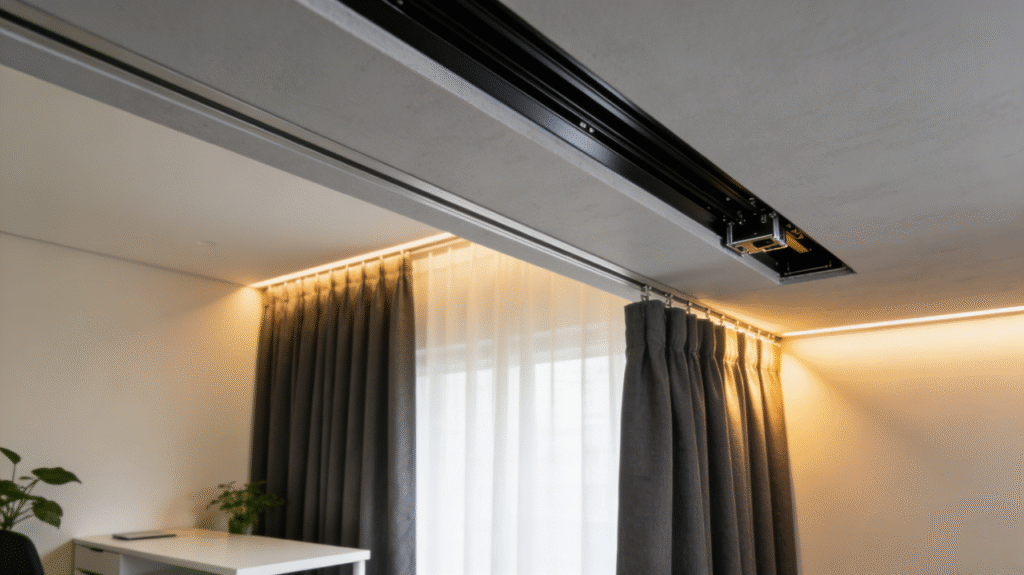
Why Hidden Curtain Tracks Are a Key Decision for B2B Projects
In recent years, hidden curtain tracks—also known as concealed or recessed curtain tracks—have become a standard specification in modern architectural design.
For B2B buyers, this is not just a design trend. Choosing whether to use hidden curtain tracks affects:
- Ceiling construction planning
- Installation sequence and coordination
- Curtain system cost structure
- Long-term maintenance accessibility
- Overall perceived property value
In hotels, apartments, villas, and smart homes, hidden curtain tracks are often expected by end users. However, they are not always the right solution for every project.
This article evaluates whether hidden curtain tracks are worth it, focusing on practical pros, real limitations, and best commercial use cases—not marketing hype.
What Are Hidden Curtain Tracks?
Definition
Hidden curtain tracks are curtain rail systems installed inside ceiling recesses, pelmets, or false ceilings, making the track itself invisible once installation is complete.
Only the curtain fabric remains visible, creating a clean, continuous visual line from ceiling to floor.
Common Types of Hidden Curtain Track Installations
- Recessed ceiling slot installation
- Curtain box / pelmet installation
- Integrated gypsum ceiling system
- Precast concrete ceiling recess (new builds)
Hidden curtain tracks can be manual or motorized, straight or curved.
Pros of Hidden Curtain Tracks (B2B Perspective)
1. Superior Visual Integration
Hidden curtain tracks align perfectly with modern minimalist and contemporary interior design.
Benefits:
- No exposed hardware
- Seamless wall-to-wall curtain appearance
- Ideal for floor-to-ceiling glazing
For developers, this translates into higher perceived unit value with minimal additional material cost.
2. Compatibility with Modern Curtain Systems
Hidden tracks support advanced systems such as:
- Wave curtains
- Double-layer curtains (sheer + blackout)
- Motorized curtain tracks
- Smart home integration
This makes them ideal for high-end residential and hospitality projects.
3. Improved Load Distribution
Hidden tracks are usually ceiling-mounted, allowing load to be distributed vertically rather than cantilevered from walls.
Typical Technical Parameters
| Parameter | Hidden Curtain Track |
|---|---|
| Load capacity | 8–12 kg per meter |
| Bracket spacing | 400–600 mm |
| Track thickness | 1.2–1.6 mm aluminum |
| Max continuous length | 6–12 m (jointed) |
This results in lower deformation risk, especially for heavy blackout curtains.
4. Reduced Visual Aging Over Time
Unlike decorative curtain rods, hidden tracks do not show:
- Paint wear
- Scratches on exposed metal
- Style obsolescence
This reduces renovation frequency for long-term rental or hospitality assets.
Cons of Hidden Curtain Tracks (Often Overlooked)
1. Higher Coordination Requirements
Hidden curtain tracks must be planned before ceiling construction.
Common coordination issues:
- Incorrect recess depth
- Misaligned ceiling slots
- Conflicts with lighting or HVAC
Once ceilings are closed, corrections are costly.
2. Installation Tolerance Is Less Forgiving
Because tracks are concealed, even small alignment errors become functional problems.
Technical tolerance:
- Maximum level deviation: ≤2 mm over 3 meters
- Maximum ceiling slot deviation: ≤3 mm
This requires experienced installers, not generic labor.
3. Maintenance Accessibility
Poorly designed concealed systems may restrict access for:
- Roller replacement
- Motor servicing
- Track cleaning
Best practice is to include removable access panels or service gaps.
4. Not Cost-Effective for All Projects
Hidden curtain tracks are not ideal for:
- Budget residential projects
- Retrofit installations without ceiling modification
- Short-term properties
In such cases, exposed tracks or rods may be more practical.
Hidden Curtain Tracks vs Exposed Systems
| Feature | Hidden Curtain Track | Exposed Track / Rod |
|---|---|---|
| Visual appearance | Minimalist, clean | Visible hardware |
| Installation planning | High | Low |
| Ceiling coordination | Required | Not required |
| Load performance | Excellent | Moderate |
| Maintenance access | Must be designed | Easy |
| Best for | New builds, premium projects | Renovations, low-budget |
Key Technical Parameters B2B Buyers Should Evaluate
1. Ceiling Recess Dimensions
Recommended minimums:
- Recess width: 120–150 mm
- Recess depth: 100–120 mm
For motorized tracks:
- Add 30–40 mm extra depth for motor housing.
2. Track Material and Finish
- Aluminum alloy 6063-T5 preferred
- Anodized or powder-coated finish
- Low-friction polymer carriers
Avoid thin-gauge aluminum below 1.0 mm thickness.
3. Motorized System Compatibility
If motorized:
- Noise level ≤35 dB
- Power supply: AC 110–240V or DC 24V
- Control: Zigbee / WiFi / RS485
Ensure motor access is planned before ceiling closure.
Best Use Cases for Hidden Curtain Tracks
1. Modern Residential Developments
- Apartments
- Condominiums
- Villas
Hidden tracks support uniform design standards across units.
2. Hotels and Serviced Apartments
Hidden tracks:
- Enhance luxury perception
- Reduce visible wear
- Support blackout and automation systems
They are now standard in 4-star and above hotels.
3. Smart Homes and Premium Projects
Motorized hidden curtain tracks integrate seamlessly into:
- Smart lighting systems
- Central control panels
- Voice-controlled environments
4. Projects Where Hidden Tracks Are NOT Recommended
- Old building renovations
- Projects with limited ceiling height
- Tight construction schedules
- Cost-driven mass housing
Common Mistakes in Hidden Curtain Track Projects
- Designing recesses too narrow
- Forgetting motor maintenance access
- Installing tracks after ceiling completion
- Using residential-grade tracks in commercial projects
- Ignoring thermal expansion (1.5–2 mm per meter)
Avoiding these mistakes significantly reduces rework and warranty claims.
Conclusion: Are Hidden Curtain Tracks Worth It?
Hidden curtain tracks are absolutely worth it when used in the right projects.
For modern residential developments, hotels, and premium smart homes, they deliver superior aesthetics, better load performance, and long-term value. However, they require early planning, precise installation, and proper maintenance access design.
For B2B buyers, the decision should not be driven by trend alone, but by project type, budget structure, and construction coordination capability. When these factors align, hidden curtain tracks are not just worth it—they become the best solution available.