

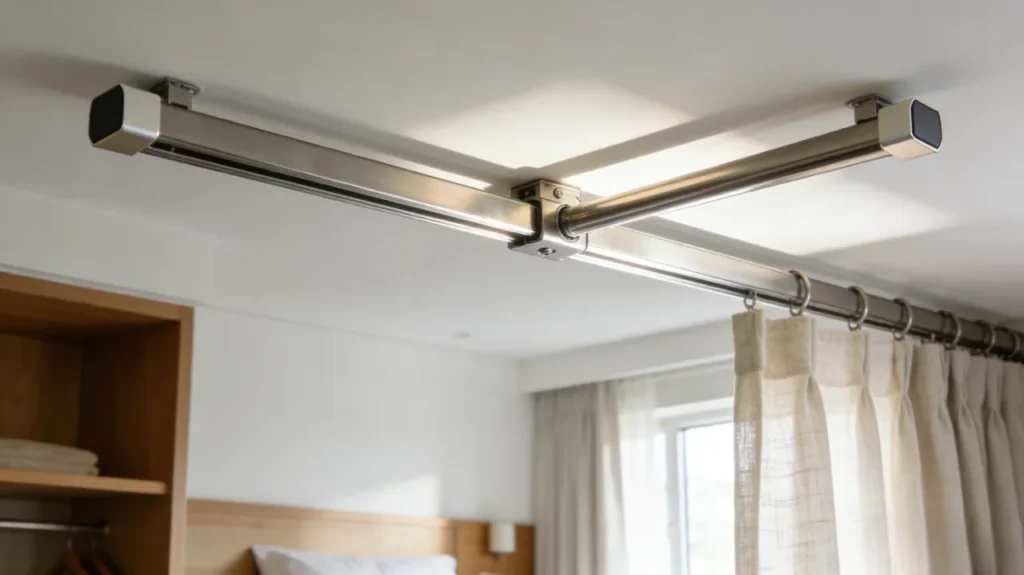
Introduction: Why Curtain Tracks Dominate Hotel and Commercial Projects
In hotel and commercial interior projects, window treatment systems are not decorative afterthoughts—they are functional infrastructure components.
Compared with residential environments, hotels, offices, hospitals, and commercial buildings place much higher demands on curtain systems in terms of:
- Daily usage frequency
- Load-bearing requirements
- Noise control
- Fire safety compliance
- Maintenance efficiency
As a result, curtain tracks have largely replaced curtain rods in professional projects. This shift is not driven by aesthetics alone, but by engineering logic, operational cost control, and long-term performance.
This article explains why curtain tracks are the preferred choice in hotel and commercial spaces, with a focus on B2B procurement decision-making and technical advantages.
Functional Demands in Hotel and Commercial Environments
Before discussing advantages, it is important to understand the specific requirements of these spaces.
High-Frequency Daily Operation
In hotels and serviced apartments:
- Curtains are opened and closed multiple times per day
- Housekeeping staff operate them at speed
- Wear and tear accumulates quickly
Standard curtain rods often fail under such conditions, while curtain tracks are designed for high-cycle operation.
Heavy and Multi-Layer Curtain Configurations
Commercial spaces commonly use:
- Blackout curtains
- Sheer + blackout double layers
- Acoustic or thermal curtains
Typical curtain system weight:
- Residential: 3–6 kg per linear meter
- Hotel/commercial: 8–15 kg per linear meter
Curtain tracks are structurally optimized to handle these loads safely.
Advantage 1: Superior Load-Bearing Performance
Structural Design of Curtain Tracks
Curtain tracks distribute curtain weight evenly along the entire track length rather than concentrating load at two rod brackets.
Typical technical parameters:
- Aluminum alloy: 6063-T5 / 6063-T6
- Profile wall thickness: 1.2–2.0 mm
- Maximum load capacity: 12–20 kg per linear meter
This makes curtain tracks suitable for:
- Floor-to-ceiling curtains
- Extra-wide window spans
- Motorized curtain systems
Reduced Risk of Structural Failure
In commercial buildings, ceiling and wall damage caused by overloaded curtain rods can result in:
- Guest complaints
- Safety hazards
- Costly repairs
Curtain tracks significantly reduce point-load stress, improving long-term structural reliability.
Advantage 2: Noise Control and Guest Experience
Silent Operation as a Service Quality Factor
In hotels, even small details affect guest satisfaction. Curtain noise is especially noticeable in:
- Early mornings
- Late nights
- Quiet luxury environments
High-quality curtain tracks achieve noise levels below 25 dB during operation, compared to 35–45 dB for standard rods.
Technical Noise-Reduction Features
Professional curtain tracks use:
- Nylon PA66 or POM roller carriers
- Precision-machined aluminum profiles
- Anti-vibration internal channels
Carrier specifications:
- Single carrier load rating: 8–12 kg
- Rolling resistance coefficient: <0.02
- Tested service life: ≥50,000 cycles
These features are essential in hospitality environments.
Advantage 3: Installation Flexibility for Complex Projects
Compatibility with Multiple Installation Methods
Curtain tracks support:
- Top mounting (ceiling-mounted)
- Side mounting (wall-mounted)
- Recessed installation in curtain boxes
This flexibility allows designers and contractors to adapt to:
- Concrete ceilings
- Gypsum board ceilings with reinforcement
- Renovation constraints
Support for Curved and Special-Shaped Windows
Hotels and commercial buildings often feature:
- Bay windows
- Corner windows
- Curved façades
Curtain tracks can be:
- Cold-bent on-site
- Factory pre-bent with radius tolerance ±3 mm
This is not feasible with rigid curtain rods.
Advantage 4: Clean Aesthetics and Design Integration
Concealed Installation for Modern Architecture
Curtain tracks can be fully hidden within:
- Ceiling recesses
- Curtain boxes
- Architectural details
This results in:
- Clean ceiling lines
- Minimal visual clutter
- Consistent interior language across rooms
For branded hotel chains, this consistency is critical.
Advantage 5: Operational Efficiency and Maintenance Savings
Reduced Maintenance Frequency
Curtain tracks experience:
- Less mechanical stress
- Slower component wear
- Fewer alignment issues
Project data indicates:
- 20–40% fewer maintenance requests
- Lower replacement rates over 5–8 years
Faster Replacement and Modular Components
Many commercial-grade curtain tracks feature:
- Modular carriers
- Replaceable end caps
- Standardized mounting accessories
This reduces:
- Downtime during repairs
- Labor cost for maintenance teams
Advantage 6: Compatibility with Fire and Safety Standards
Commercial projects often require compliance with:
- Fire-retardant curtain fabrics
- Non-combustible or low-smoke materials
Curtain tracks made from aluminum alloy:
- Do not contribute to flame spread
- Meet common building safety requirements
This is a key consideration for hospitals, hotels, and public buildings.
Advantage 7: Long-Term Cost Efficiency (TCO)
Lower Total Cost of Ownership
Although curtain tracks may have a higher initial cost than rods, they offer:
- Longer service life
- Reduced failure risk
- Lower maintenance and replacement costs
From a B2B procurement perspective, curtain tracks deliver better long-term ROI.
Typical Commercial Application Scenarios
Hotels and Resorts
- Guest rooms
- Lobbies
- Conference rooms
Office Buildings
- Meeting rooms
- Executive offices
- Shared workspaces
Healthcare and Education
- Patient rooms
- Classrooms
- Privacy partitions
Curtain tracks provide reliable performance across all these environments.
Conclusion: Curtain Tracks Are the Professional Standard for Commercial Projects
The advantages of using curtain tracks in hotel and commercial spaces are rooted in engineering performance, operational efficiency, and long-term value.
Compared with curtain rods, curtain tracks offer:
- Higher load capacity
- Quieter operation
- Greater design flexibility
- Lower maintenance costs
For B2B buyers, contractors, and hospitality operators, curtain tracks are not a premium upgrade—they are the professional standard for delivering reliable, safe, and high-quality commercial interiors.