

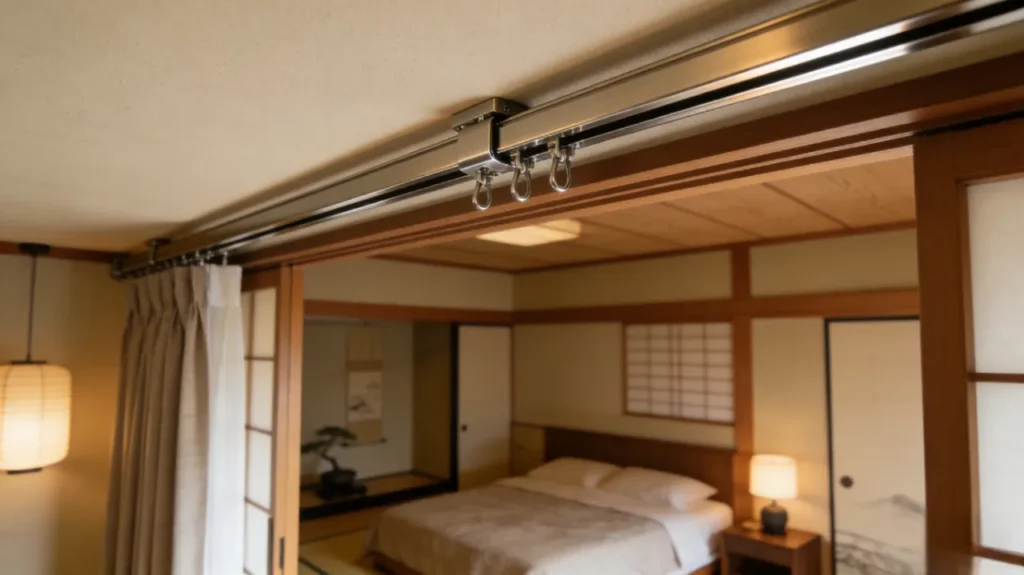
Introduction: Silent Curtain Tracks Are No Longer a “Premium Option”
Over the past five years, silent curtain tracks have shifted from a niche, premium accessory to a standard specification in many residential projects. For B2B suppliers, OEM manufacturers, and project contractors, this shift reflects deeper changes in:
- Residential quality standards
- User expectations for comfort
- Building acoustic requirements
- Long-term maintenance cost control
More families are choosing silent curtain tracks not because of marketing trends, but because traditional curtain tracks increasingly fail to meet modern living requirements.
This article explains the reasons behind this demand growth, focusing on technical structure, performance data, and project-level value rather than consumer-level descriptions.
What Are Silent Curtain Tracks?
Definition from a Technical Perspective
A silent curtain track is a curtain rail system engineered to minimize friction noise, vibration, and mechanical resonance during operation. Noise reduction is achieved through a combination of:
- Optimized aluminum profile design
- High-precision roller carriers
- Noise-absorbing internal materials
- Controlled tolerance between moving components
Unlike standard tracks, silent curtain tracks are designed with acoustic performance as a core parameter, not an afterthought.
Why Traditional Curtain Tracks Are Being Replaced
1. Noise Issues Become More Noticeable in Modern Homes
Modern residential buildings feature:
- Larger glass areas
- Harder surface finishes
- Lower ambient background noise
In this environment, even minor friction or vibration from a curtain track becomes noticeable—especially in bedrooms and children’s rooms.
Traditional curtain tracks typically generate:
- 35–45 dB friction noise during sliding
- Increasing noise after 12–18 months of use due to wear
Silent curtain tracks reduce operational noise to below 25 dB, a threshold generally perceived as “near silent” in residential environments.
2. Increasing Use of Heavy and Multi-Layer Curtains
Families increasingly choose:
- Blackout curtains
- Thermal insulation curtains
- Double or triple-layer curtain systems
These significantly increase load requirements.
Load comparison (per linear meter):
- Standard curtain track: 5–8 kg
- Silent reinforced curtain track: 8–15 kg
Silent curtain tracks often use:
- Thicker aluminum profiles (≥1.2 mm)
- Reinforced internal ribs
- Higher-density carrier systems
This makes them better suited for modern curtain configurations.
Core Technical Advantages of Silent Curtain Tracks
Optimized Aluminum Profile Structure
Silent curtain tracks typically use 6063-T5 or 6063-T6 aluminum alloy, selected for:
- High strength-to-weight ratio
- Dimensional stability
- Smooth internal surface finish
Common technical parameters:
- Profile wall thickness: 1.2–1.6 mm
- Internal track tolerance: ±0.15 mm
- Surface treatment: anodized ≥10 μm or powder coating ≥60 μm
These parameters directly influence sliding smoothness and durability.
Advanced Carrier and Roller Systems
The carrier system is the core noise-control component.
High-quality silent tracks use:
- Nylon PA66 rollers with self-lubricating properties
- Stainless steel or POM axles
- Dual-wheel or quad-wheel load distribution
Typical specifications:
- Single carrier load rating: 8–12 kg
- Rolling resistance coefficient: <0.02
- Service life: ≥50,000 cycles
Lower rolling resistance equals less noise and reduced track wear.
Integrated Noise-Reduction Materials
Some silent curtain tracks incorporate:
- PVC or rubber noise-damping strips
- Soft-contact carrier housings
- Anti-resonance cavity designs
These elements absorb vibration instead of transmitting it to the ceiling or wall structure—critical for apartments and hotels.
Why Silent Curtain Tracks Are Preferred in Residential Projects
Improved User Experience with Measurable Value
From a B2B perspective, “user experience” must translate into quantifiable benefits:
- Fewer post-installation complaints
- Reduced maintenance calls
- Higher client satisfaction ratings
- Lower warranty claim rates
Project data from residential developments shows:
- Complaint rate reduction: 30–45%
- Maintenance frequency reduction: 20–35%
Better Compatibility with Modern Interior Design
Silent curtain tracks are typically designed for:
- Concealed installation
- Curtain boxes
- Minimalist ceiling lines
Their low-profile design supports current architectural trends without visible hardware.
Application Scenarios Driving Demand Growth
Bedrooms and Children’s Rooms
Noise sensitivity is highest in these spaces. Silent curtain tracks prevent:
- Early-morning noise disturbance
- Sleep interruption
- Friction sounds amplified by quiet environments
High-End Apartments and Villas
Buyers increasingly evaluate quality through details and tactile experience, where noise-free curtain operation becomes a subtle but impactful factor.
Renovation and Upgrade Projects
In renovation markets, silent curtain tracks offer:
- Perceived quality upgrade
- Minimal visual change
- Clear functional improvement
This makes them an easy “value add” for developers and contractors.
Silent Curtain Tracks from a B2B Procurement Perspective
Lower Total Cost of Ownership (TCO)
Although silent curtain tracks may cost 10–25% more upfront, they offer:
- Longer service life
- Fewer replacements
- Reduced after-sales labor
For large projects, this results in lower lifecycle cost, not higher.
Stronger Product Differentiation for Distributors
For distributors and wholesalers, silent curtain tracks allow:
- Clear product tiering
- Higher average order value
- Reduced price-only competition
They also align well with private-label and OEM strategies.
Conclusion: Silent Curtain Tracks Reflect the New Standard of Residential Quality
More and more families are choosing silent curtain tracks because residential quality standards have fundamentally changed.
From a B2B perspective, silent curtain tracks are not a trend product, but a structural upgrade driven by noise control requirements, heavier curtain systems, and long-term performance expectations.
For manufacturers, distributors, and project buyers, silent curtain tracks offer:
- Higher perceived value
- Lower lifecycle cost
- Stronger market differentiation
As residential projects continue to prioritize comfort and durability, silent curtain tracks are becoming the default specification rather than an optional upgrade.