

Introduction
“How long should a curtain rod be?” is one of the most common yet frequently misunderstood questions in the window treatment industry. While the answer may appear simple for residential consumers, B2B buyers and project-based clients require a far more precise, standardized, and technically grounded approach.
For curtain manufacturers, wholesalers, hotel project contractors, interior design firms, and bulk importers, incorrect curtain rod sizing can lead to:
- Installation failures
- Light leakage issues
- Customer complaints
- Increased after-sales costs
This guide explains how long a curtain rod should be from a professional B2B perspective, incorporating engineering tolerances, curtain styles, load capacity, installation standards, and project-level best practices. The goal is to help you specify, source, and standardize curtain rod lengths accurately across different commercial scenarios.
The General Rule: How Long Should a Curtain Rod Be?
From an industry-standard perspective:
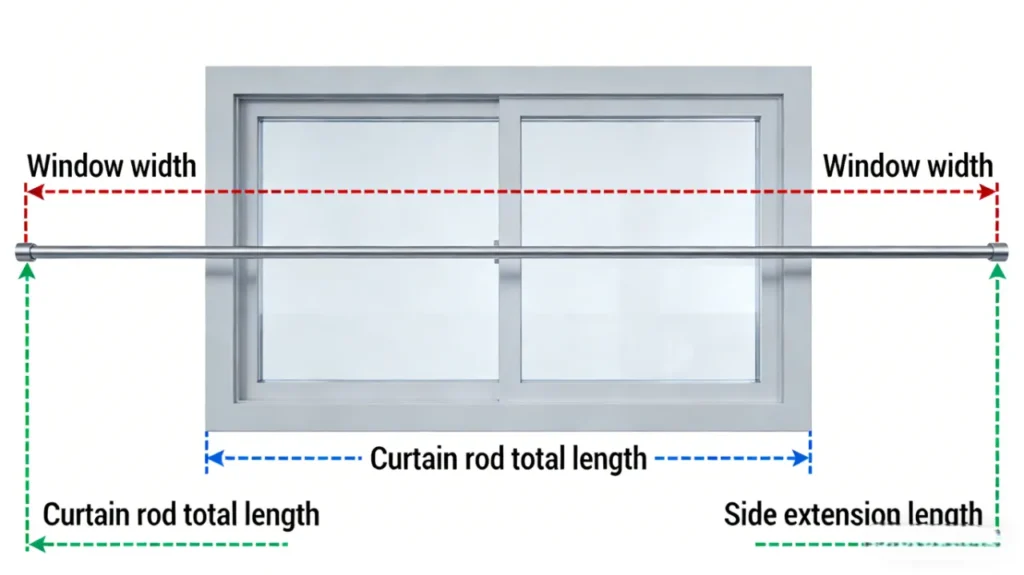
A curtain rod should be 8–16 inches (20–40 cm) wider than the window opening.
This means the rod extends 4–8 inches on each side of the window frame.
This rule is widely adopted across:
- Hospitality projects
- Residential developments
- Retail-ready curtain sets
- OEM curtain rod manufacturing
The extension allows curtains to:
- Fully clear the window when open
- Maximize natural light
- Create balanced visual proportions
Why Curtain Rod Length Matters in B2B Projects
For B2B buyers, curtain rod length is not just an aesthetic decision—it is a functional and operational specification.
Incorrect rod length can result in:
- Curtains blocking glass area when open
- Inadequate light control
- Uneven fabric stacking
- Increased fabric wear
- Non-compliance with project drawings
Standardizing curtain rod length helps reduce:
- Installation errors
- SKU complexity
- On-site adjustments
- Return and replacement rates
Curtain Rod Length Formula (Professional Standard)
Recommended Industry Formula
Curtain Rod Length = Window Width + 8–16 inchesRecommended Extension by Project Type
| Project Type | Extension per Side |
|---|---|
| Residential bulk supply | 4–6 inches |
| Hotels & serviced apartments | 6–8 inches |
| Blackout applications | 8–10 inches |
| Decorative-only curtains | 4 inches |
Curtain Rod Length by Window Width (Reference Table)
| Window Width | Recommended Rod Length |
|---|---|
| 36 in (91 cm) | 44–52 in |
| 48 in (122 cm) | 56–64 in |
| 60 in (152 cm) | 68–76 in |
| 72 in (183 cm) | 84–88 in |
| 84 in (213 cm) | 96–104 in |
| 96 in (244 cm) | 110–120 in |
For windows wider than 90 inches, center support brackets or reinforced rods are required.
Curtain Rod Length by Curtain Type (Critical for B2B)
Different curtain styles directly affect the required rod length.
Rod Pocket Curtains
Rod pocket curtains slide minimally and rely on fabric gathering.
Recommended rod length:
- Window width + 8–12 inches
B2B note:
- Avoid excessive extension
- Suitable for decorative or semi-static installations
- Common in budget hotels and residential projects
Grommet / Eyelet Curtains
Grommet curtains slide smoothly and stack evenly.
Recommended rod length:
- Window width + 12–16 inches
B2B note:
- Ideal for retail-ready curtain sets
- Better light exposure when open
Ring Top Curtains
Ring top curtains require extra side clearance for stacking.
Recommended rod length:
- Window width + 14–18 inches
Blackout & Thermal Curtains
Used extensively in hospitality projects.
Recommended rod length:
- Window width + 16–20 inches
Technical reason:
- Additional width minimizes side light leakage
- Allows overlap beyond window edge
Inside Mount vs Outside Mount: Length Differences
Outside Mount (Most Common in Projects)
- Rod mounted above and beyond window frame
- Better light control and coverage
Length rule:
- Add 8–16 inches to window width
Inside Mount (Limited Use)
- Rod mounted inside window recess
- Rod length = exact inside frame width
Limitations:
- Reduced stacking space
- Not suitable for thick or blackout curtains
Engineering & Technical Parameters (Often Overlooked)
Maximum Span Without Center Support
| Rod Diameter | Max Span (No Support) |
|---|---|
| 16 mm | ≤ 48 in |
| 19 mm | ≤ 60 in |
| 22 mm | ≤ 72 in |
| 25 mm | ≤ 90 in |
Beyond these spans, center brackets are mandatory.
Load Capacity Considerations
- Lightweight curtains: 3–5 kg
- Standard curtains: 6–10 kg
- Blackout curtains: 12–15 kg
Rod length directly affects load distribution and bracket spacing.
Hotel & Commercial Project Best Practices
For hospitality and large-scale projects, industry best practice is:
- Standard extension: 6 inches per side
- Rod height: 4–6 inches above window frame
- Bracket spacing: ≤ 120 cm
- Material: powder-coated steel or aluminum alloy
These standards simplify procurement and installation across multiple rooms.
Common B2B Mistakes to Avoid
- Rod length equal to window width
- No allowance for curtain stack-back
- Oversized rods without center support
- Using consumer-grade rods for commercial loads
Manufacturing & OEM Sizing Recommendations
For OEM/ODM suppliers:
- Offer telescopic size ranges (e.g. 66–120 in)
- Clearly label recommended window width
- Specify maximum supported span
- Include bracket quantity per size
This reduces misuse and after-sales disputes.
Conclusion
So, how long should a curtain rod be?
From a professional and B2B standpoint, the answer is clear: a curtain rod should extend 8–16 inches beyond the window width, with adjustments based on curtain type, load requirements, and installation method.
For manufacturers, wholesalers, and project buyers, applying standardized curtain rod length rules reduces installation errors, improves curtain performance, and lowers long-term operational costs. When combined with correct material selection and support spacing, proper curtain rod sizing becomes a reliable foundation for successful window treatment projects.