

Introduction
A shower curtain ceiling track is no longer a niche bathroom accessory. In hotels, serviced apartments, healthcare facilities, student housing, and renovation projects, ceiling-mounted shower curtain track systems have become a standard specification for space efficiency, water containment, and long-term durability.
This guide is written for B2B buyers, project managers, contractors, architects, and procurement teams who need a complete, technical, and decision-oriented understanding of shower curtain ceiling tracks — from materials and structural parameters to installation methods, compliance standards, and lifecycle cost considerations.
What Is a Shower Curtain Ceiling Track?
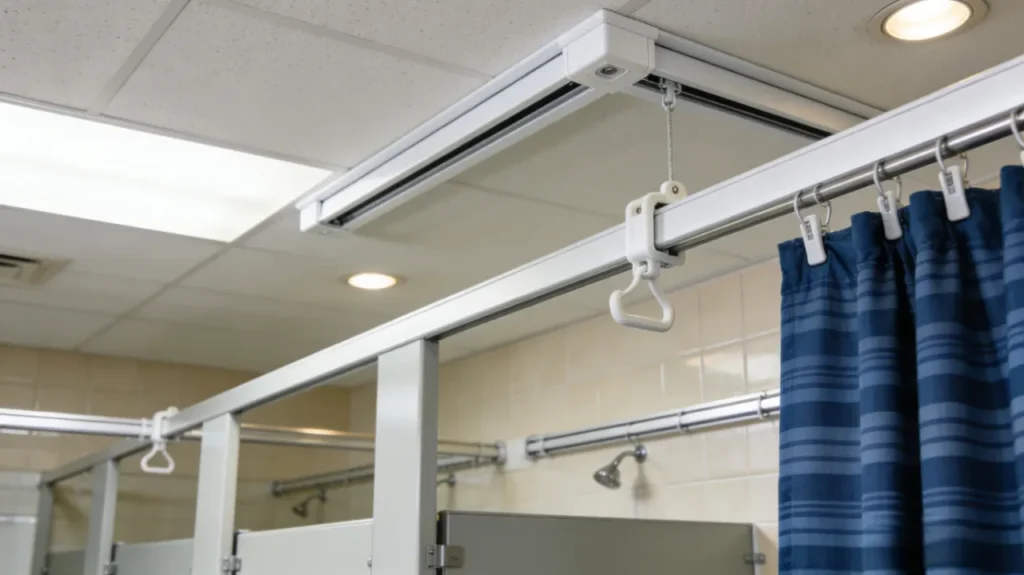
A shower curtain ceiling track is a ceiling-mounted rail system designed to support shower curtains, allowing smooth horizontal movement while keeping water contained within the shower area.
Unlike wall-mounted rods, ceiling tracks:
- Do not rely on sidewall strength
- Enable flexible shower layouts
- Provide better curtain sealing
- Are compatible with commercial-grade bathrooms
Common B2B synonyms include:
- Ceiling mounted shower curtain track
- Shower curtain ceiling rail system
- Bathroom ceiling curtain track
- Commercial shower curtain track
Why Ceiling-Mounted Tracks Are Preferred in Commercial Projects
From a professional standpoint, ceiling-mounted systems outperform wall-mounted solutions in several key areas:
1. Structural Stability
Ceiling slabs (concrete or reinforced gypsum) offer higher load-bearing consistency than tiled sidewalls, especially in renovations.
2. Space Optimization
In compact bathrooms, ceiling tracks:
- Free wall space for grab bars and accessories
- Allow full-height curtain drops
- Reduce splash zones beyond the shower area
3. Design Flexibility
Ceiling tracks support:
- Straight, L-shaped, U-shaped, and curved layouts
- Walk-in showers
- Barrier-free and ADA-compliant designs
Core Components of a Shower Curtain Ceiling Track System
Understanding system components is critical for accurate specification and procurement.
1. Track Profile
Typical commercial profiles:
- Material: Aluminum alloy 6063-T5 / 6061-T6
- Width: 18–30 mm
- Height: 10–15 mm
- Surface finish: Anodized (≥10 μm) or powder-coated
Slim-profile tracks are preferred in modern architectural projects.
2. Roller / Carrier System
Often overlooked, the roller system determines noise level and service life.
Key technical details:
- Roller core: POM (polyoxymethylene)
- Axle pin: Stainless steel 304
- Operating noise: ≤35 dB
- Load rating: 1.5–2.0 kg per roller
Commercial systems typically use 8–12 rollers per meter.
3. Ceiling Mounting Hardware
| Ceiling Type | Fixing Method |
|---|---|
| Concrete | M6 expansion anchors |
| Gypsum board | Toggle bolts + reinforcement |
| Metal ceiling | Self-drilling screws |
Bracket spacing is usually 400–600 mm depending on load requirements.
Types of Shower Curtain Ceiling Tracks (B2B Classification)
1. Straight Ceiling Track Systems
Best for: Hotels, apartments, modular bathrooms
- Standard lengths: 1.2 m / 1.8 m / 2.4 m
- Can be cut to size on-site
- Lowest unit cost
- High installation efficiency
2. Curved & Radius Ceiling Tracks
Best for: Corner showers, accessible bathrooms
Technical parameters:
- Minimum bending radius: 300 mm
- Arc options: 90°, 135°, 180°
- Reinforced bracket requirement
These systems maximize internal shower space in small bathrooms.
3. Custom-Length & OEM Ceiling Track Systems
Best for: High-end residential and branded hospitality projects
Features:
- CNC cut with ±1 mm tolerance
- Concealed fasteners
- Custom finishes (RAL / Pantone)
OEM ceiling tracks improve brand consistency across multi-property portfolios.
4. Antibacterial & Medical-Grade Ceiling Tracks
Best for: Hospitals, clinics, senior care facilities
Special characteristics:
- ISO 22196 antibacterial surface
- Non-porous anodized coating
- Compatible with medical privacy curtains
Often required in government and public-sector tenders.
Installation Considerations (Professional Focus)
Ceiling Load & Deflection Control
Recommended standards:
- Maximum deflection: ≤1/300 span
- Safety factor: ≥2× rated load
- Static load test: ≥30 kg per linear meter
Improper load calculation is a common cause of premature failure.
Maintenance & Lifecycle Cost (TCO)
| Component | Typical Lifecycle |
|---|---|
| Aluminum track | 8–12 years |
| Roller carriers | 24–36 months |
| Shower curtains | 6–12 months |
B2B buyers should prioritize standardized spare parts to reduce long-term maintenance costs.
Compliance & Certification Requirements
Professional procurement often requires:
- ISO 9001 manufacturing certification
- RoHS & REACH compliance
- Material test reports
- Load testing documentation
For hospitality and healthcare projects, documentation is often as important as the product itself.
Common Procurement Mistakes (And How to Avoid Them)
- Choosing wall-mounted rods for high-traffic bathrooms
- Ignoring ceiling substrate type during specification
- Underestimating roller quality
- Mixing incompatible curtain hooks and carriers
- Selecting non-standard profiles that complicate maintenance
Conclusion
A shower curtain ceiling track is a critical functional component in modern bathroom design, particularly for commercial and multi-unit projects. For B2B buyers, success lies in selecting systems that balance structural performance, material quality, installation compatibility, and long-term maintenance efficiency.
By understanding technical parameters, compliance standards, and real-world usage demands, procurement teams and contractors can confidently specify ceiling-mounted shower curtain tracks that deliver durability, safety, and design flexibility across any project scale.