

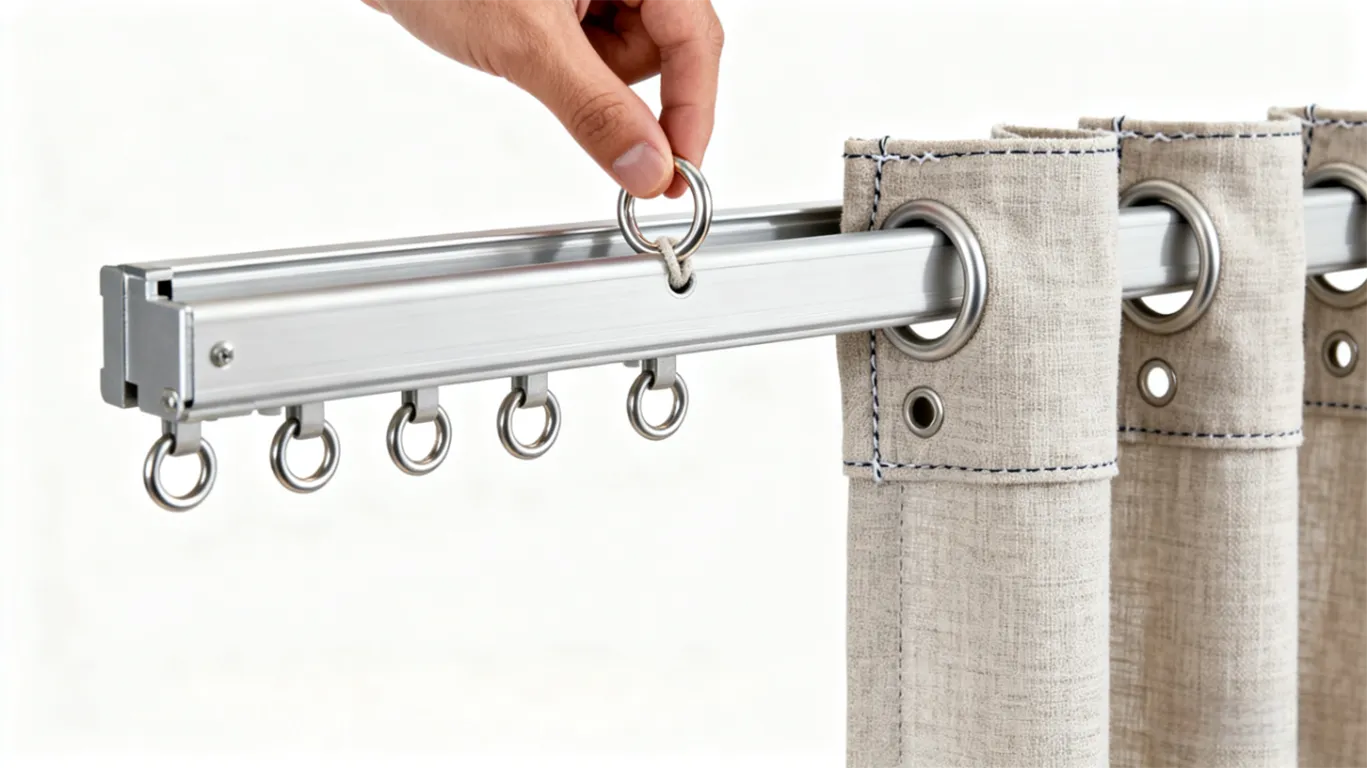
1. Introduction: Why Curtain Tracks Dominate Commercial Applications
When working on large-scale commercial or hospitality projects—hotels, hospitals, offices, multi-unit apartments—curtain tracks often outperform curtain rods due to their:
- Higher load capacity (up to 12–18 kg/m depending on material)
- Smoother gliding performance
- Compatibility with heavy blackout fabrics
- Low-profile design for ceiling or recessed installations
- Better compliance with fire-safety & accessibility standards (ADA, EN 13120)
This guide provides step-by-step instructions on how to hang curtains on a track, including technical measurements and best practices for B2B procurement and installation teams.
2. Understanding Curtain Track Systems (B2B Technical Overview)
Commercial curtain track systems generally fall into these categories:
2.1 Aluminum Extruded Tracks
- Common spec: 6063-T5 aluminum alloy
- Load rating: 8–15 kg/m
- Applications: Hotels, offices, apartments
- Features: Lightweight, rust-proof, flexible in custom lengths
2.2 Steel Reinforced Tracks
- Load rating: 12–20 kg/m
- Applications: Heavy drapery, multi-layer curtains
- Features: High rigidity, fire-safe coating
2.3 Bendable PVC/Aluminum Hybrid Tracks
- Minimum bending radius: 12–15 cm
- Applications: Bay windows, hospital cubicles
- Features: Quiet movement, custom curvature
2.4 Ceiling-Mounted vs. Wall-Mounted Tracks
- Ceiling-mounted for blackout rooms, hotel partitions
- Wall-mounted for residential or office windows
3. Required Tools and Curtain Components
Before hanging curtains on a track, ensure the installation team prepares:
Track Components
- Curtain track rail (aluminum / steel)
- End caps with anti-slip lock
- Gliders or rollers(nylon / POM material)
- Hooks (S-hook, pinch-pleat hook, micro-hook)
- Brackets (wall or ceiling type)
- Mounting plates (if suspended)
Tools
- Impact drill (6mm/8mm bit depending on wall type)
- Spirit level (±0.5 mm accuracy)
- Screwdriver (torque 4–5 N⋅m recommended)
- Measuring tape
- Anchors (nylon wall plug or metal expansion anchor)
4. Step-by-Step: How to Hang Curtains on a Track
Step 1: Measure the Window and Determine Track Length
Measurement standards for professional projects:
| Measurement | Specification |
|---|---|
| Track extension | Window width + 15–25 cm each side |
| Ceiling gap | 2–4 cm from ceiling for clearance |
| Floor clearance | 1–1.2 cm |
| Distance between brackets | 40–60 cm (heavy fabric: 30–40 cm) |
Pro tip: For tracks over 2.5 meters, add a reinforced center bracket to avoid sagging.
Step 2: Install the Brackets
Wall-mounted installation
- Use 6×30 mm nylon anchors for brick walls
- Use 8×60 mm metal anchors for concrete walls
- Torque tightening: 4–5 N⋅m
Ceiling-mounted installation
- Bracket spacing: 40–50 cm
- Use anti-vibration washers in hotels & hospitals
Ensure the track is perfectly level (tolerance ±0.3°).
Step 3: Insert Gliders or Rollers Into the Track
Commercial-grade gliders typically use:
- Material: nylon (PA66) or POM
- Noise level: <30 dB sliding noise
- Load: 1.2–3.5 kg per glider
Average density:10–14 gliders per meter depending on curtain pleat style.
Long-tail keywords hit:
curtain track gliders、curtain rollers for track、glider spacing for curtains
Step 4: Attach Hooks to the Curtains
Different curtains require different hook types:
Pinch pleat curtains
- Use stainless steel pleat hooks
- Hook spacing: 8–12 cm
- Ensure height alignment per pleat
Pencil pleat curtains
- Adjustable 3-row pocket system
- Best for commercial flexibility
S-hook / micro-hook curtains
- Used in healthcare cubicles & bay windows
Step 5: Hang Curtains on the Track
Simply clip or hook each curtain hook onto the gliders.
Professional note:
For blackout hotel curtains, ensure the overlap area is 8–12 cm to prevent light leakage.
Step 6: Test the Sliding Performance
To achieve professional-grade operation:
- Sliding force should be <2.0 N for standard tracks
- Ensure there is no snag or friction point
- Apply silicone-based rail lubricant (never oil-based)
This step is crucial for hotels and commercial environments.
5. Common Problems & Solutions (B2B Troubleshooting)
Problem 1: Curtains snag when sliding
Cause:Track misalignment
Solution:Re-level the track within ±0.3°
Problem 2: Track sagging in the middle
Cause:Bracket spacing too wide
Solution:Add center bracket at 30–40 cm intervals for heavy curtains
Problem 3: Noise during movement
Cause:Low-grade plastic gliders
Solution:Use POM quiet-glide rollers (<30 dB)
6. Industry Use Cases and Compliance Standards
Commercial procurement customers often ask for:
- Fire-resistant curtains: NFPA 701 / BS 5867
- Anti-bacterial fabrics for hospitals
- ADA accessibility requirements(smooth glide & low force)
- ISO-certified track materials
Reassuring B2B buyers with compliance data significantly improves trust and conversion.
7. Conclusion
Hanging curtains on a track is straightforward when following professional installation standards—precise measurement, correct bracket spacing, proper glider density, and compliance with commercial safety requirements. For B2B customers, selecting the right heavy-duty track system ensures smooth movement, long-term durability, and reliable performance in hospitality, healthcare, office, and residential development projects. By integrating industry-level parameters and standard-compliant materials, you ensure both functional excellence and project-grade reliability.